Luminous Brilliance: The Artistry of Zibo Liuli
Contemporary
Liu Yuan, Wang Tongqiang
Length 35 cm; Width 35 cm; Height 70 cm
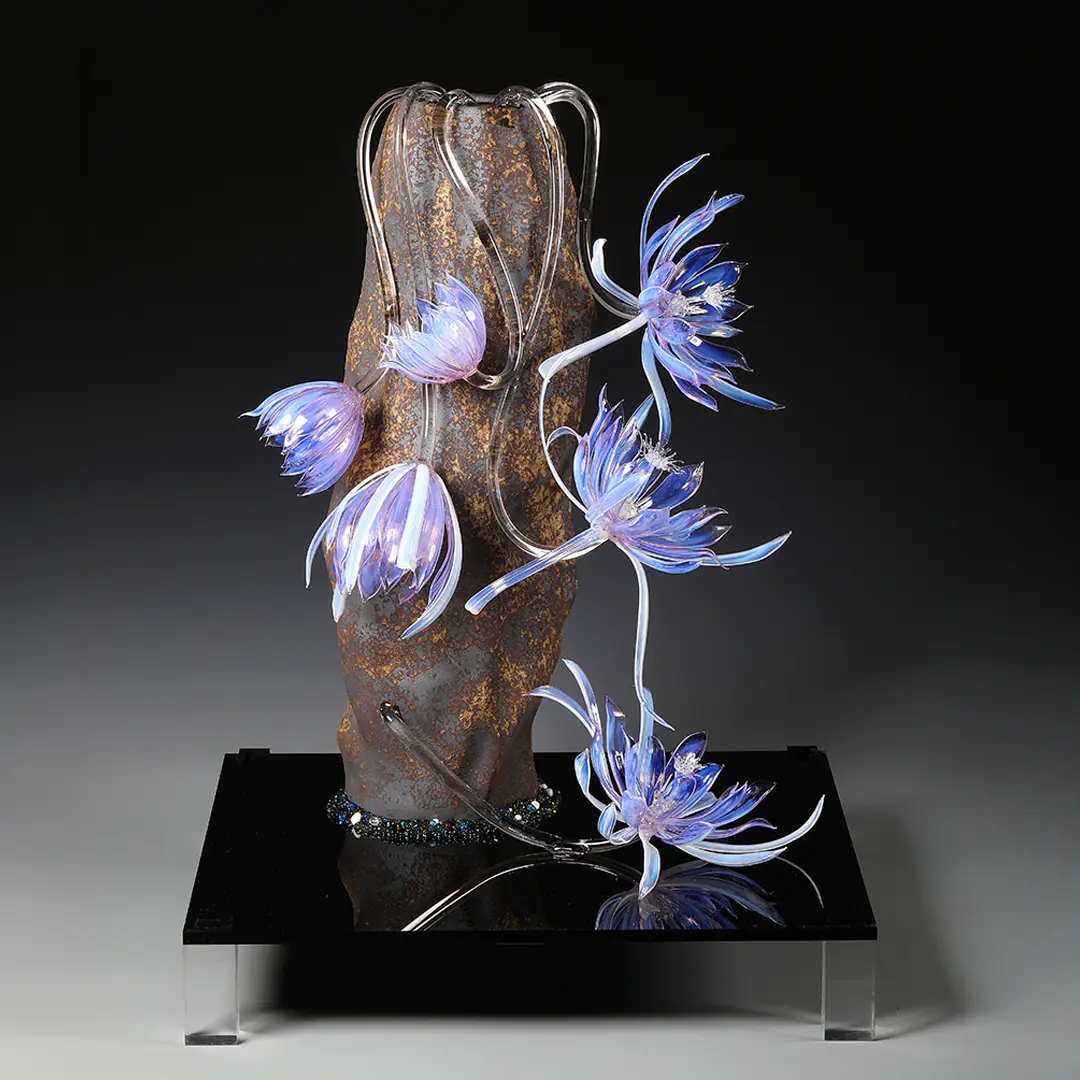
Eternity
The liuli artwork before you is titled Eternity, jointly created by contemporary liuli artists Liu Yuan and Wang Tongqiang.
The work depicts a blooming cereus flower. Often known in Chinese culture as “the beauty beneath the moon,” the cereus is admired for its rare and short-lived blossom. Through the medium of liuli, the artists have captured its most enchanting moment in full bloom. This idea of preserving a fleeting moment is reflected in the work's title, Eternity.
The work was crafted using lampworked liuli, a traditional technique closely associated with Zibo. Artisans repeatedly heat the liuli over a high‑temperature flame until it becomes soft and pliable. Working quickly and with great precision, they pull, twist, stretch and bend the molten material to form each delicate petal. Every curve of the flower and every outward-reaching stamen must be completed in a single continuous process before the liuli cools and hardens. The technique demands exceptional control, timing and craftsmanship.
Rendered in dreamlike shades of violet and blue, the layered petals unfold gracefully, revealing the flower’s elegance and ethereal beauty.
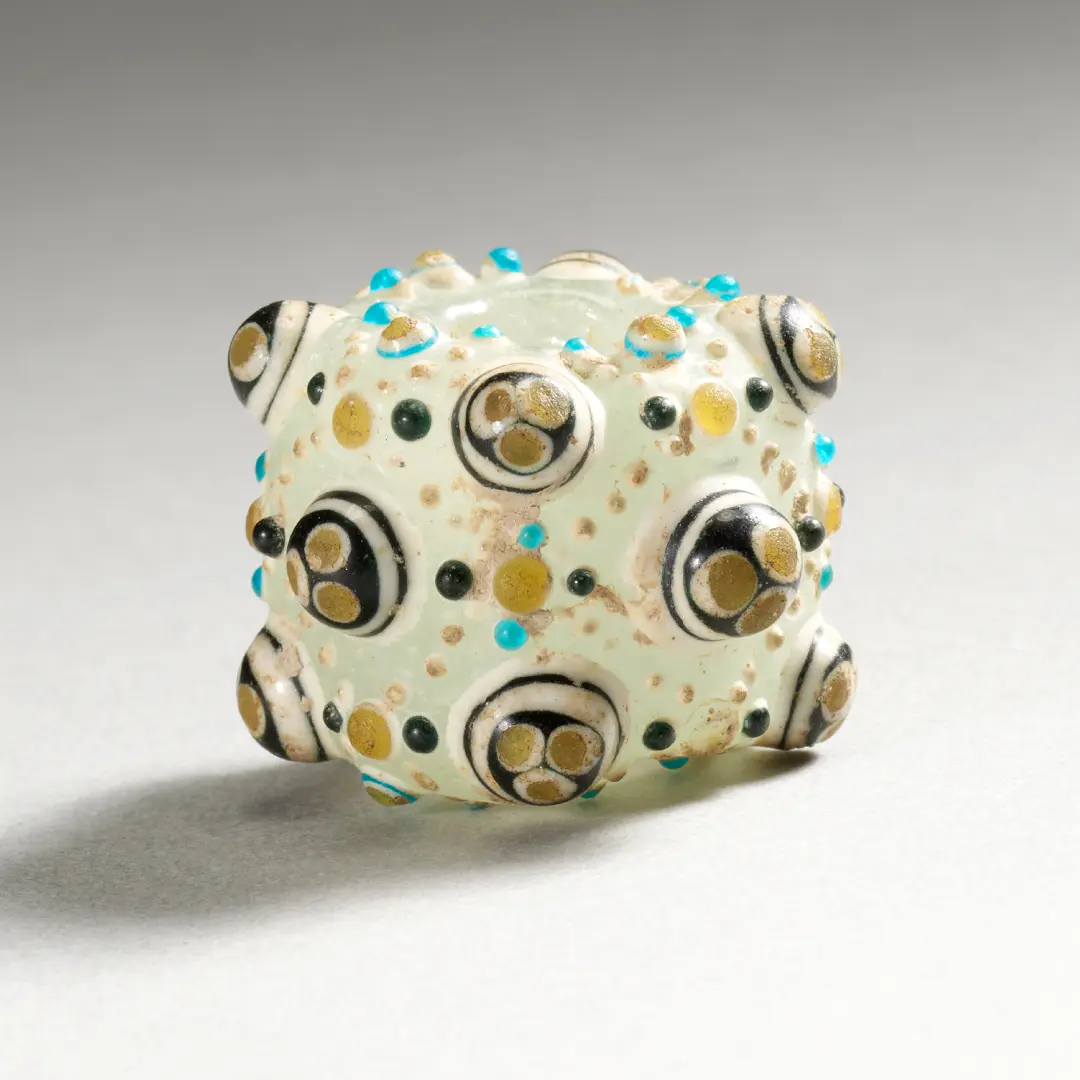
Warring States Period
Collection of the National Museum of China
Diameter 2.4 cm; Height 2 cm
Dragonfly-Eye Liuli Bead
This dragonfly-eye liuli bead was created by inlaying concentric circles of colored glass onto a glass body. The technique is believed to have originated in Central or West Asia before being introduced to China, where it underwent further development.
Similar beads have been discovered across China, Southeast Asia, West Asia, and the eastern Mediterranean, often sharing remarkably similar forms and decorative patterns. These discoveries provide important evidence for understanding the development of ancient glass making and the cultural exchanges that connected these regions.
Dragonfly-eye beads first appeared in West Asia and were later introduced to China through long-distance trade networks. Most examples are spherical or cylindrical in shape, with a hole running through the center for stringing. Their surfaces are decorated with colored glass, commonly in shades of blue, white, and yellow, arranged in concentric circles or geometric patterns. Some of these designs are slightly raised, creating eye-like motifs with a striking sense of depth.
Among the dragonfly-eye beads unearthed in China, some were imported from the West and made from soda-lime glass, a material widely used in the ancient West. Others were produced locally using China's distinctive lead-barium glass. In ancient China, dragonfly-eye beads were primarily used as ornaments, appearing on necklaces, waist decorations, and even in burial furnishings.
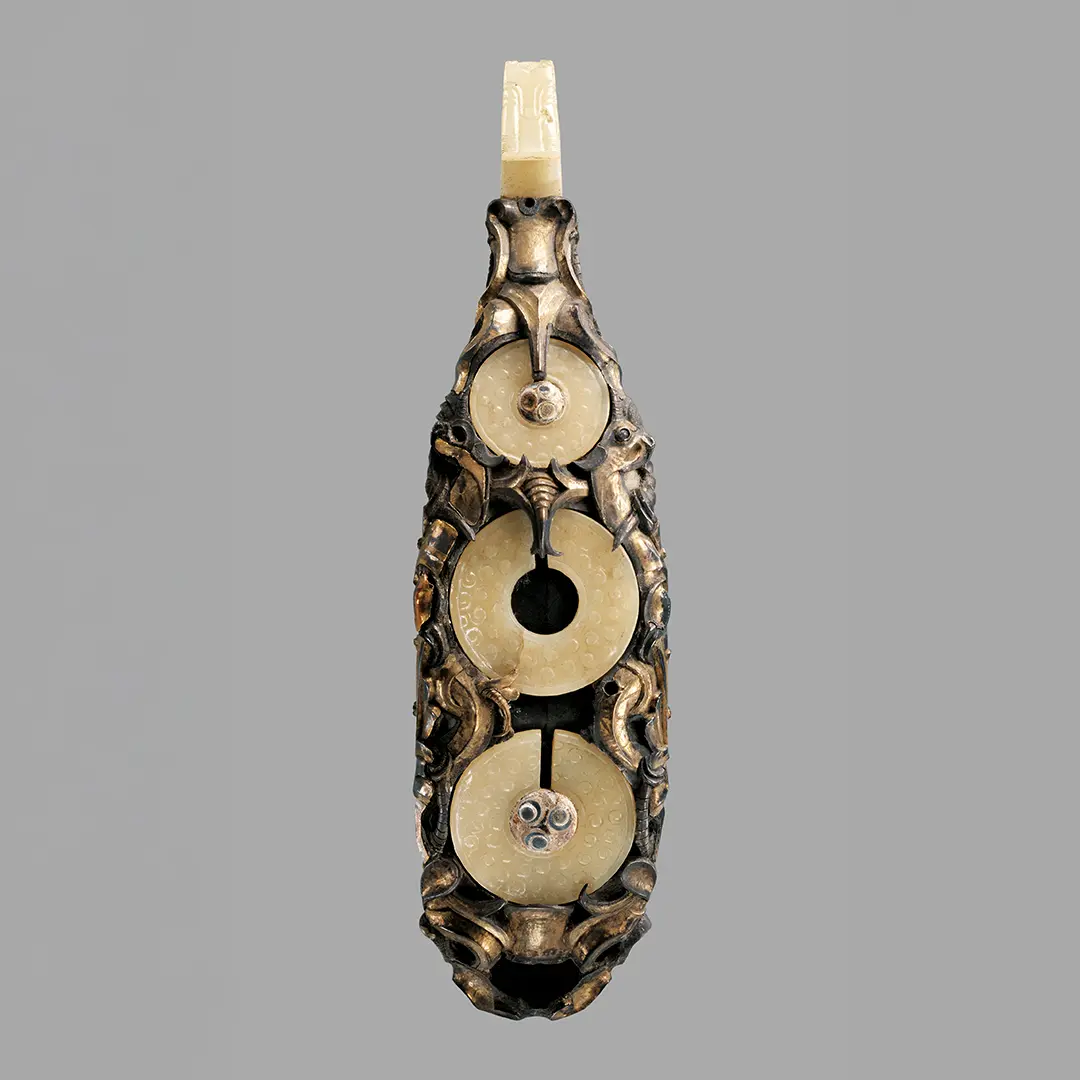
Warring Status Period
Collection of the National Museum of China
Length 18.7 cm; Width 4.9 cm
Silver Belt Hook Inlaid with Gold, Jade, and Liuli (Replica)
This belt hook was excavated from the royal cemetery at Guwei Village in Huixian, Henan Province. Belt hooks were ornamental fasteners worn at the waist and became especially popular during the Warring States period.
The hook takes the form of a dragon's head carved from pale greenish-white jade. Its body is shaped like a lute and decorated with silver-gilt reliefs of paired kui dragons, mythical creatures frequently seen in ancient Chinese art. Along the center are three white jade rings carved with grain patterns. Set within each ring was a dragonfly-eye liuli bead, although one of the beads is now missing. The end of the hook is decorated with a kui dragon-head motif, though the inlaid element that once accompanied it is no longer in place.
Combining jade carving, gilding, metalwork and liuli inlay in a single object, the belt hook reflects both the ingenuity of its design and the technical mastery of Warring States artisans. Richly decorated and meticulously crafted, it stands as an outstanding example of luxury craftsmanship in ancient China.
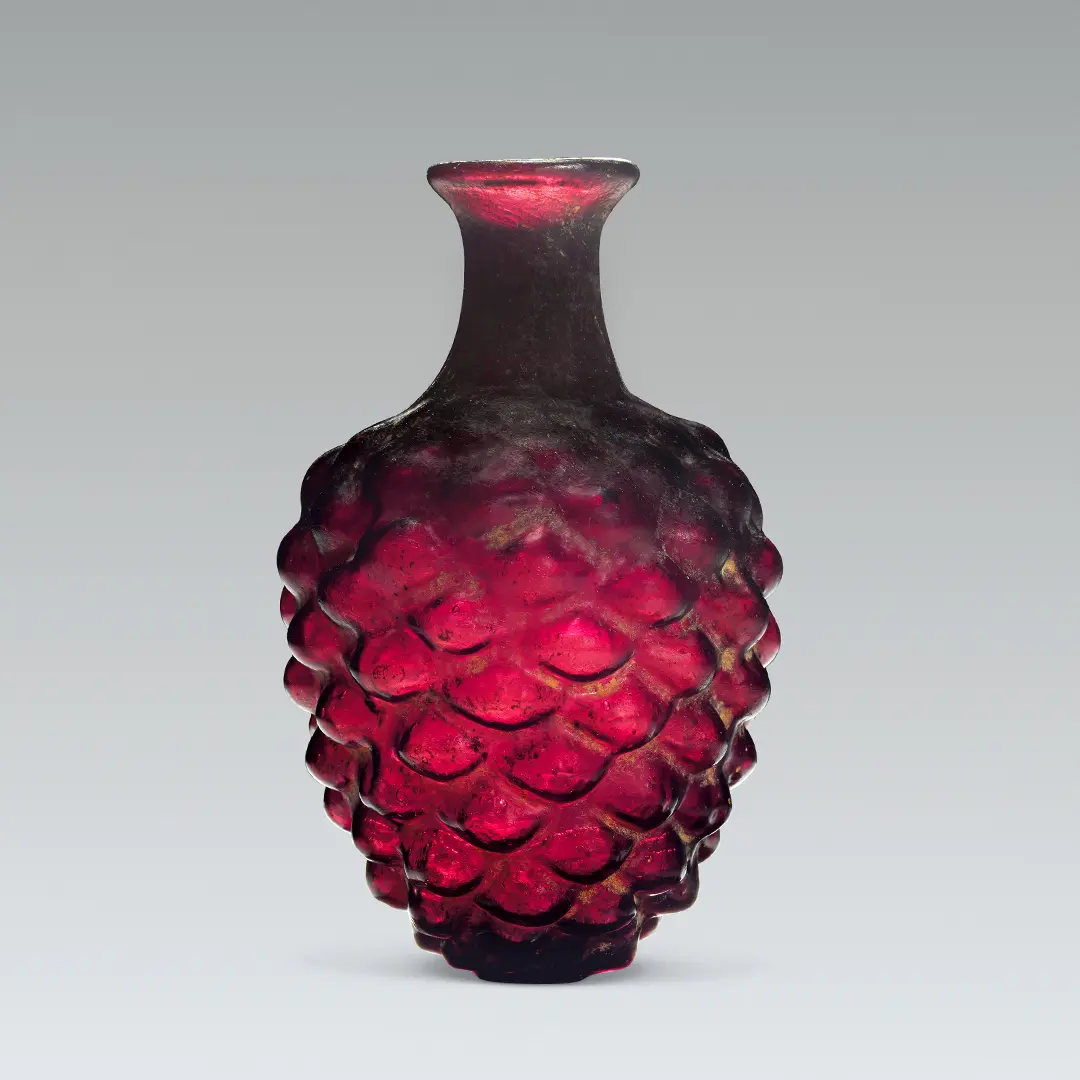
1st century CE
Collection of the National Museum of China
Rim diameter 3 cm; Belly diameter 7.2 cm; Height 11.8 cm
Grape-Shaped Glass Bottle
This glass vessel from the Roman Empire is fashioned in the form of a cluster of grapes. Its translucent deep reddish-brown body is rounded and full, while the surface is adorned with raised bosses fashioned to resemble tightly clustered grapes.
The bottle was made using mold-blowing technique. Molten glass was placed into a pre-made mold decorated with a grape pattern and then inflated by blowing air into it. Both the vessel's shape and its textured surface were formed in a single process, without any subsequent carving or decoration.
Mold-blowing became a highly developed glassmaking technique during the Roman Empire. By enabling craftsmen to produce intricate forms more efficiently, it made the large-scale production of decorative vessels possible.
This type of glass bottle like this was among the most popular forms of Roman glassware. They were commonly used to hold perfumes, fragrant oils, and ointments, combining practical functions with an appealing naturalistic design.
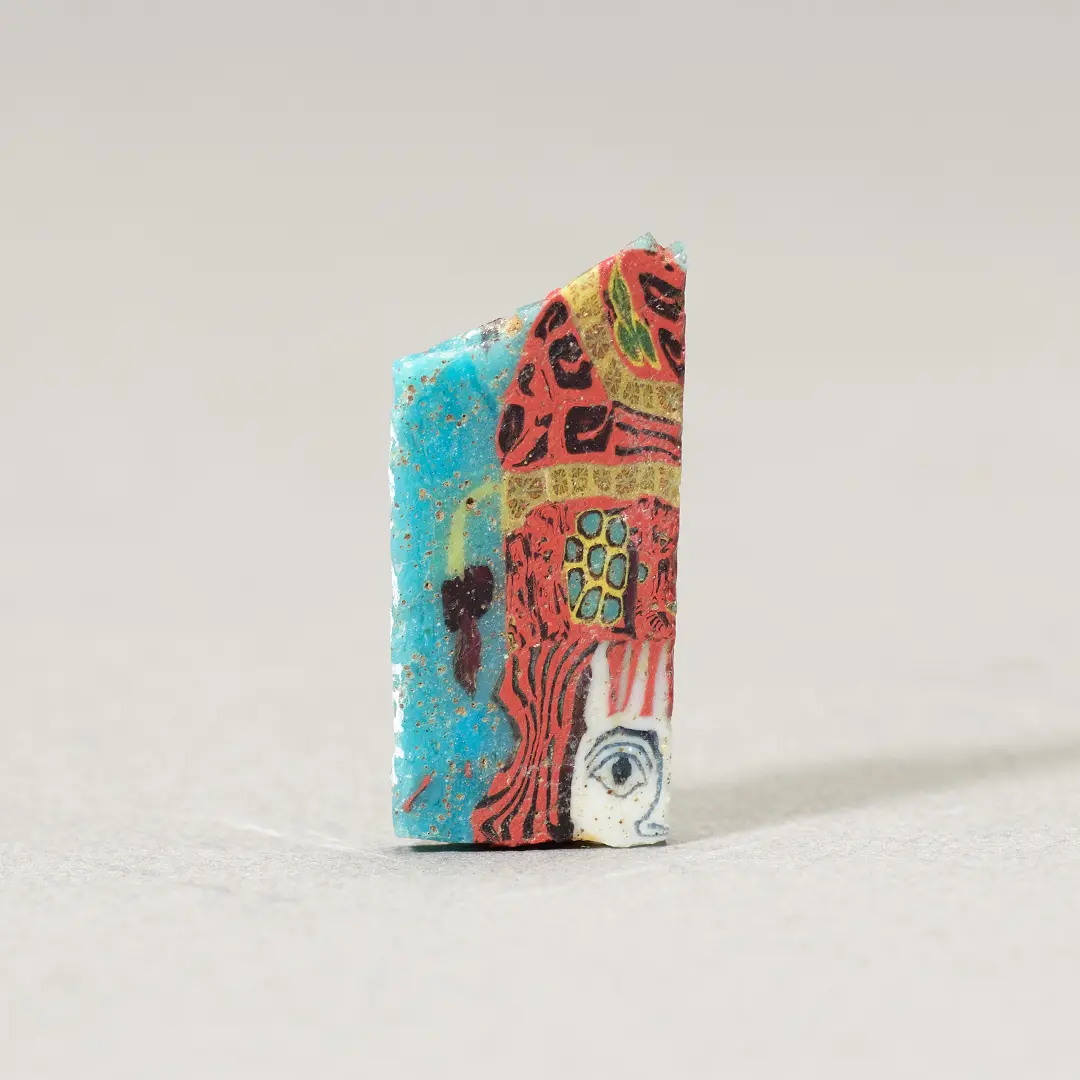
1st century BCE - 1st century CE
Collection of the National Museum of China
Length 1.1 cm; Height 2.5 cm; Thickness 0.2 cm
Fragment of a Mosaic Glass Portrait
Although only a fragment survives, this mosaic glass portrait remains striking for its rich palette and vibrant colors. It was produced using a mold-forming technique.
The art of mosaic glasswork originated in Ancient Egypt and was further developed and refined in Ancient Greece during the fourth century BCE. To create these intricate designs, artisans first arranged glass rods of different colors and patterns into carefully planned bundles. The bundles were heated until the rods softened and fused together, and then they were stretched and cut into sections. These sections were subsequently arranged to form the desired image or pattern and heated once more, which caused them to fuse into a single block of glass. After cooling and edge-finishing, the completed glass was placed into a mold for its final shaping.
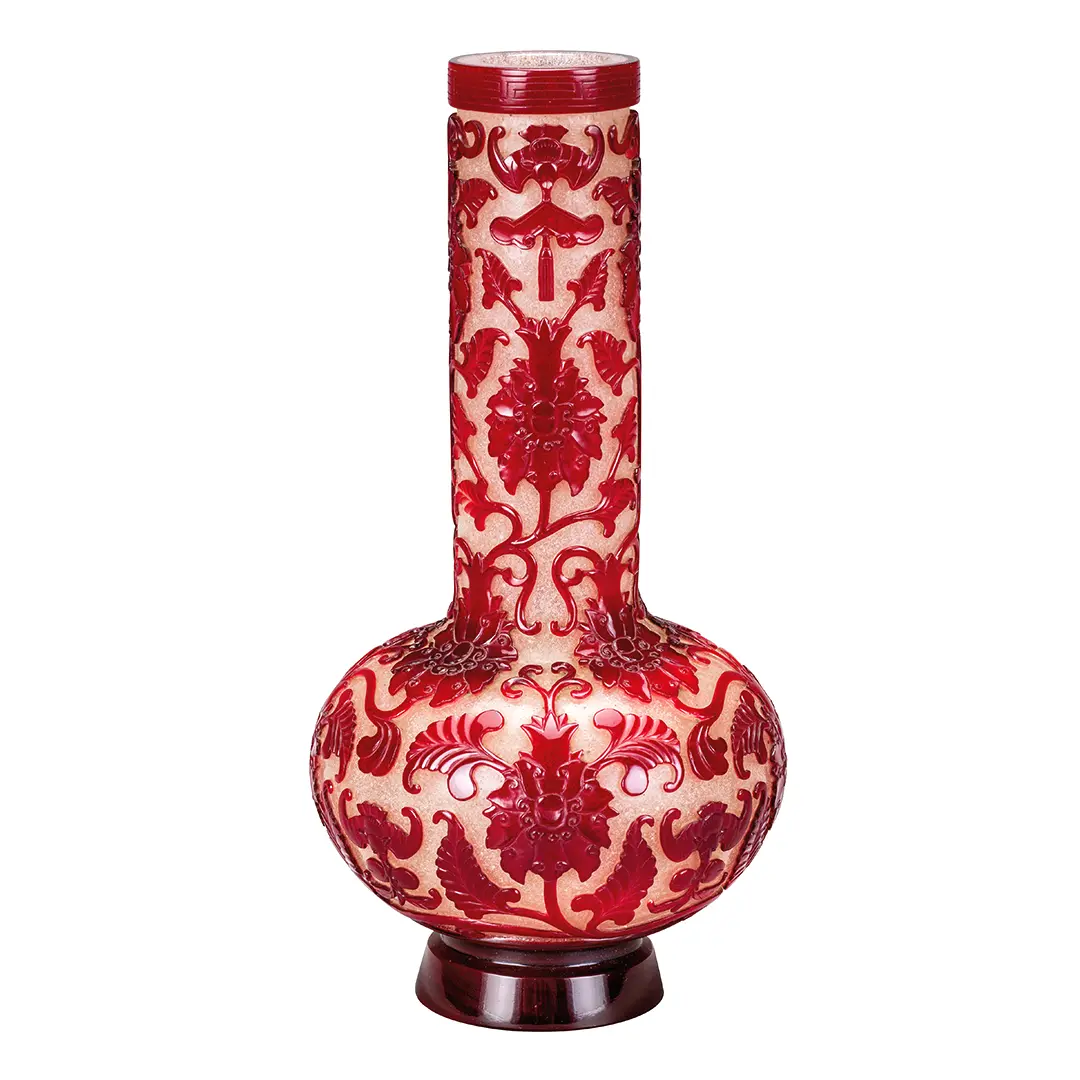
Qing Dynasty
Collection of the National Museum of China
Belly diameter 11.5 cm; Foot diameter 5.9 cm; Height 23 cm
White-Ground Overlay Ruby-Red Glass Vase with Lotus Scrolls
This vase was created using the overlay glass carving technique, representing one of the most distinctive forms of Qing imperial glassware. An opaque creamy-white glass body is overlaid with a layer of rich ruby-red glass, which is then carved to create decorative designs. The neck and body are densely ornamented with scrolling lotus vines, their stems flowing continuously across the surface in graceful lines. Among the lotus scrolls are bats and chime-shaped motifs, together forming the rebus fu qing, meaning "blessings and joy", and expressing wishes for good fortune and lasting prosperity.
Overlay glass was a hallmark of glassmaking during the Qianlong period of the Qing dynasty. Produced exclusively for the imperial court by the Imperial Glass Workshop, these objects were created by applying a layer of colored glass over a glass body of a contrasting color. The surface was then carved and polished using techniques derived from jade carving, a highly demanding process. Most overlay glass vessels were made for display.
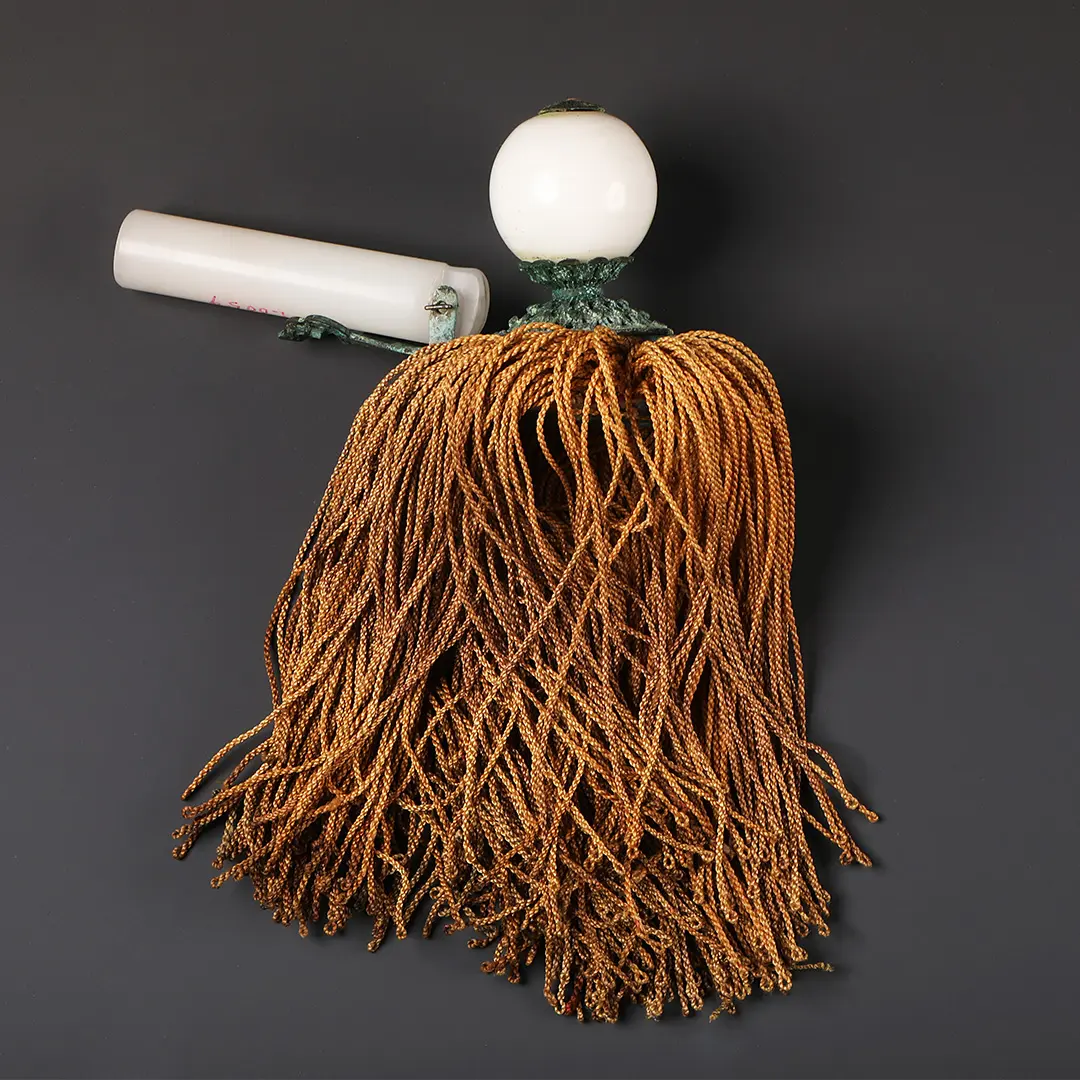
Qing Dynasty
Collection of the Zibo Ceramic and Glass Museum
Overall length 10.5 cm; Overall height 6 cm
Liuli Hat Finial
This liuli hat finial was part of the standard attire worn by Qing dynasty officials. It provides a tangible illustration of the highly structured ranking system reflected in official attire.
The set survives with its original components largely intact. At the top is a translucent white liuli bead supported by a bronze base decorated with carved motifs. Attached to the side is a plume holder made of liuli imitating white jade, which was used to secure peacock feathers or blue plumes worn by officials. Below hangs a complete bronze-colored silk tassel. Together, these elements form a finely preserved example of Qing official headwear.
Under the ceremonial regulations of the Qing dynasty, the hat finial was one of the principal indicators of an official's rank, with different materials corresponding to different grades of office. Liuli fashioned to resemble jade was commonly used for the finials of middle- and lower-ranking officials.
Though small, this liuli finial reflects both the hierarchical culture of the Qing bureaucracy and the long-standing tradition of liuli production in Zibo. It offers a striking example of how a single object can illustrate both official ritual and craftsmanship.
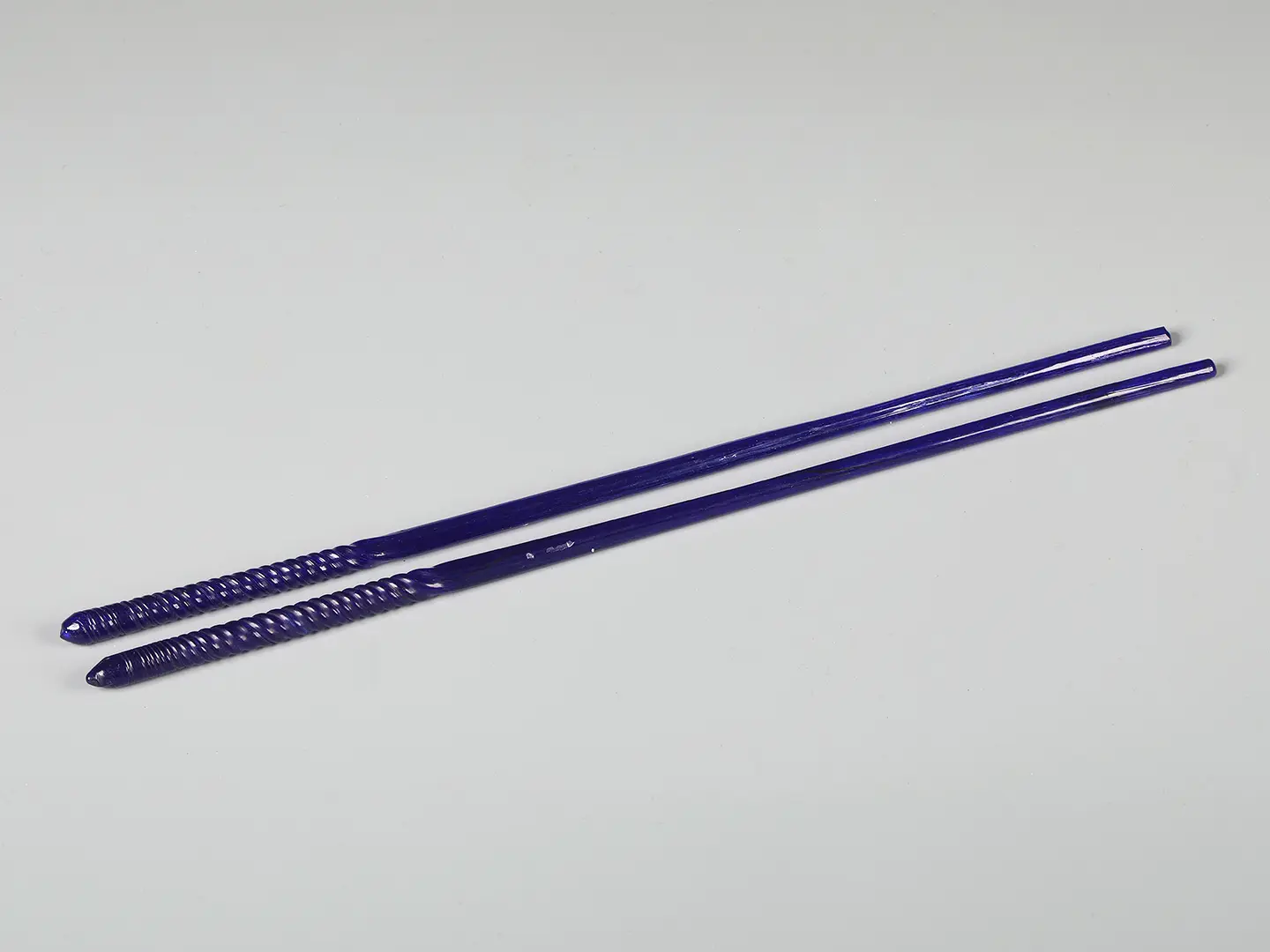
Republic of China Period
Collection of the Zibo Ceramic and Glass Museum
Length 23.6 cm
Liuli Chopsticks
The chopsticks were handmade and shaped through hot-working over a small furnace. During the period of the Republic of China, most liuli chopsticks were drawn as solid rods, while examples featuring twisted patterns or layered colors were relatively uncommon. Because liuli was expensive to produce, highly fragile, and difficult to manufacture without defects, liuli chopsticks were not ordinary household utensils. Instead, they were regarded as refined objects, used as decorative furnishings or elegant dining ware. They were often associated with formal banquets and cultivated domestic settings.
Forged in the heat of the furnace and embellished with intricate twisted patterns, these chopsticks elevate what began as an everyday utensil into a valuable testament to regional liuli craftsmanship. They also offer a glimpse into the remarkable skill of liuli artisans, who transformed simple forms into objects of beauty through precision and imagination.
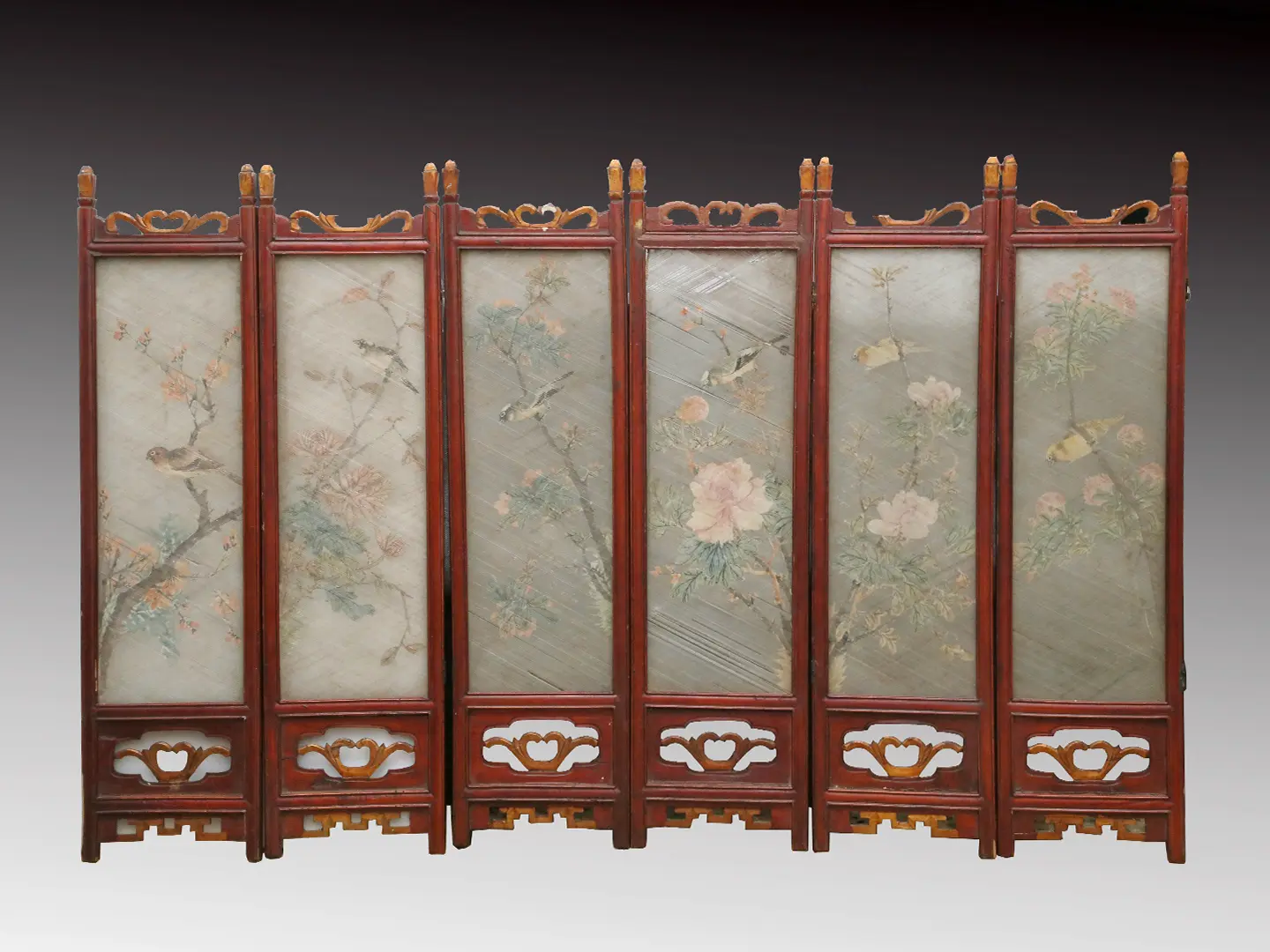
Republic of China Period
Collection of the Zibo Ceramic and Glass Museum
Width 110 cm; Height 86.5 cm
Six-Panel Screen with Inlaid Liuli Threads
This six-panel screen dates to the Republic of China period. It was prized as a decorative furnishing by scholars and collectors, valued for both its practical function and artistic appeal.
Its most distinctive feature is the screen panel, which was created using the liuli thread weaving technique, a traditional craft unique to Boshan. Artisans draw molten liuli into filaments as fine as hair, then arrange them in intersecting layers to form a translucent surface. When illuminated, the screen allows light to pass through while obscuring direct view beyond it, creating a soft and subtly diffused visual effect.
The screen adopts a folding six-panel structure, set in a carved hardwood decorated with traditional motifs, including scrolling foliage and ruyi cloud patterns. The panels are further embellished with finely painted flowers and birds representing the four seasons. Peonies, plum blossoms, chrysanthemums, and auspicious birds appear throughout the composition, conveying wishes for prosperity, peace, and good fortune.
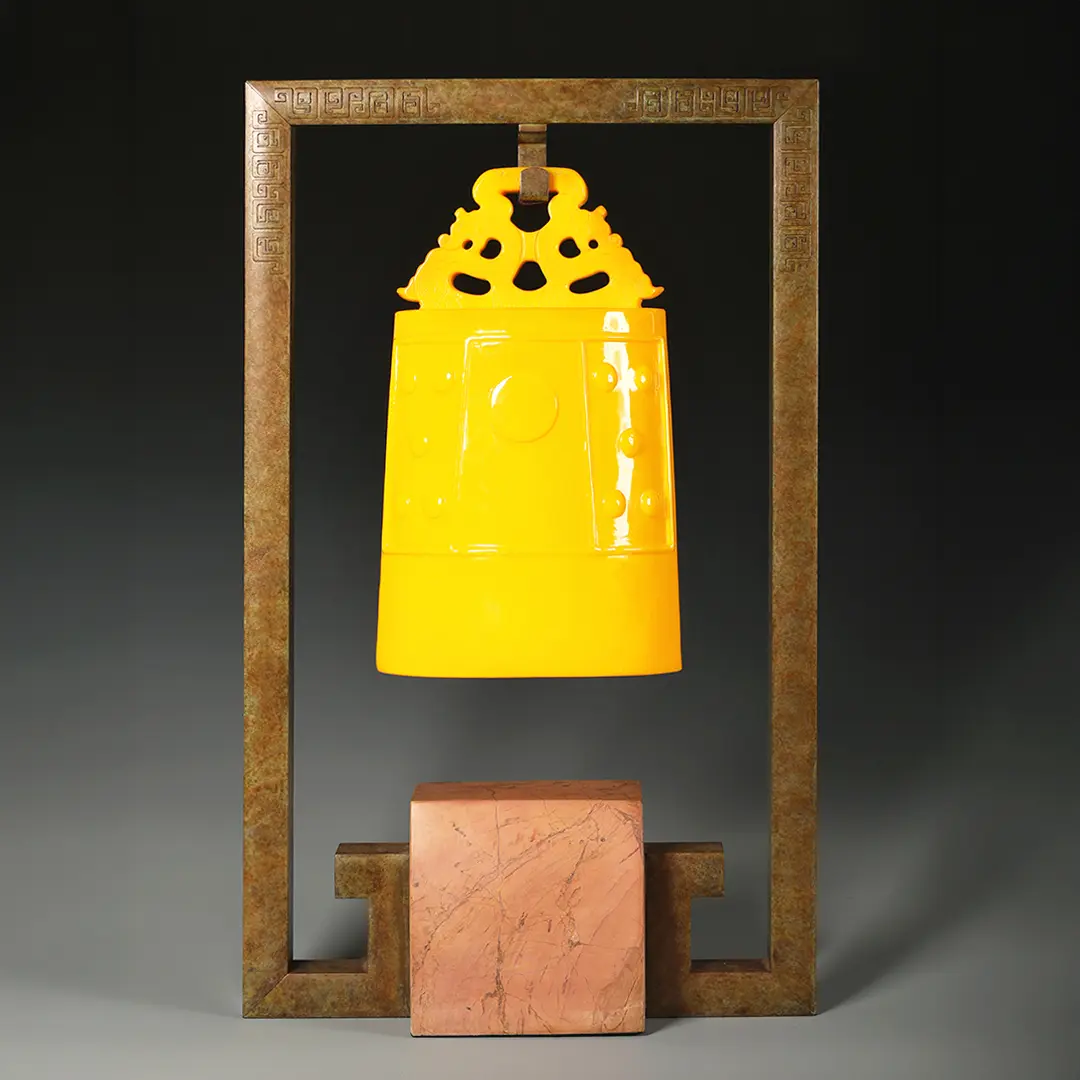
Contemporary
Sun Yunyi
Length 35.5 cm; Width 12.5 cm; Height 58.5 cm (including base)
Chicken-Fat Yellow Chime Bells
This chime bell, rendered in chicken-fat yellow liuli, is among the celebrated works of Sun Yunyi, a Chinese master craftsman. The piece is formed from a single seamless body of precious chicken-fat yellow liuli. Appearing warm and luminous, it displays a rich golden-yellow color with a glossy, jade-like translucency.
Known as the "Imperial Yellow," chicken-fat yellow was one of the glass colors reserved for court use during the Ming and Qing dynasties. Its production relied on a highly complex firing technique that was lost for more than a century. Through persistent experimentation, generations of Boshan liuli artisans gradually restored the process and brought it to new levels of refinement.
Inspired by the ancient bronze bianzhong, or chime bell, the artist brings together imperial glassmaking traditions and the cultural legacy of ritual music. When illuminated, warm layers of light appear to flow within the work. A gentle tap on its surface produces a clear and lingering tone.
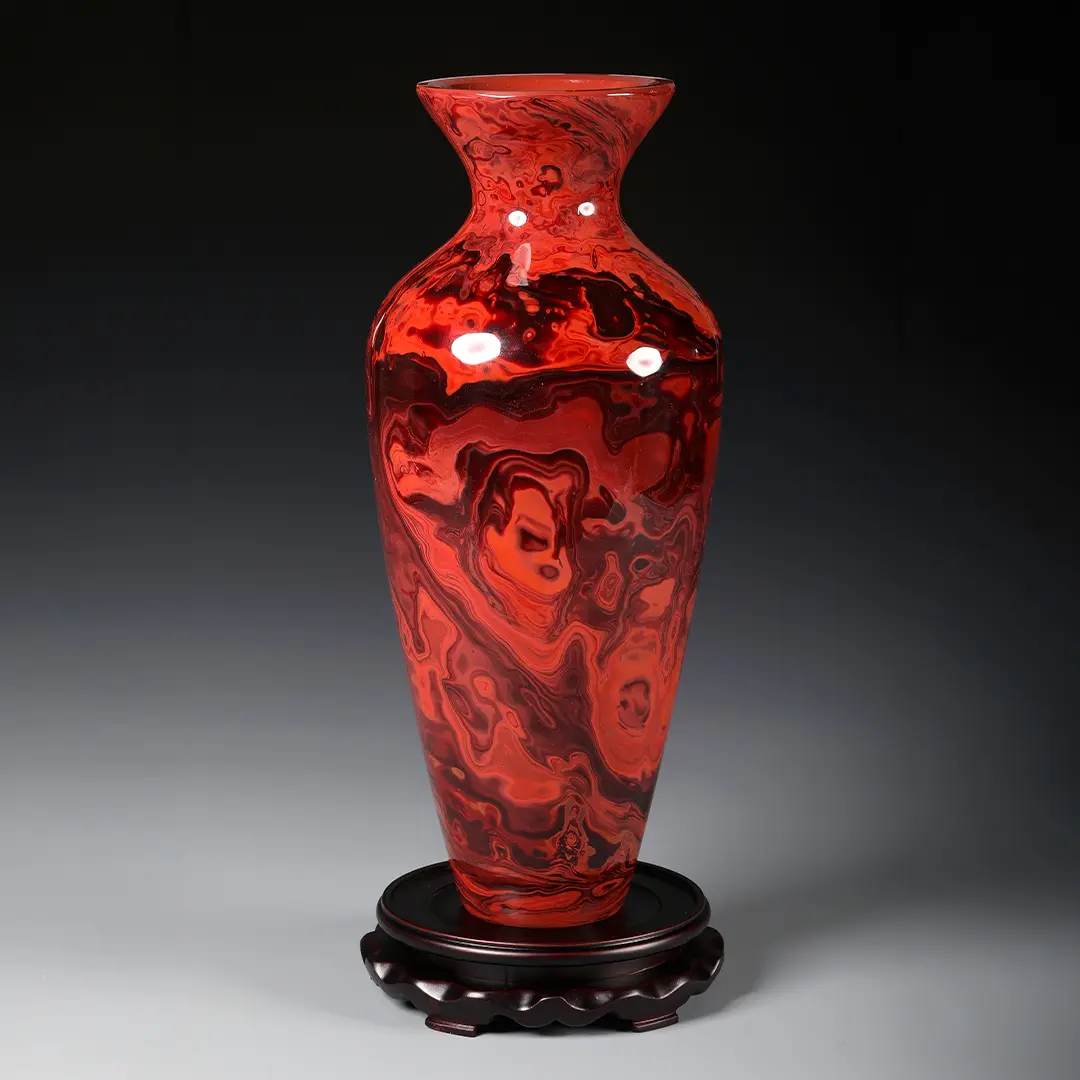
Contemporary
Sun Yunyi
Belly diameter 12 cm; Height 30 cm
Nazha Conquers the Sea
Nezha Conquers the Sea is one of the signature works of Sun Yunyi, a Chinese master craftsman. Crafted from the rare Boshan chicken-liver stone liuli, it brings together the beauty of kiln transformation and the imagination of Chinese folk mythology.
Made with minerals such as copper and iron fired at high temperature, chicken-liver stone liuli displays a characteristic deep, warm tone and black veining patterns emerged through kiln transformation. Given the exceptionally volatile firing process, no two firing cycles produce the exact same result, which makes it one of the most prized forms of liuli in Boshan.
This work was formed as a single piece using a blowing technique, without any later carving or surface modification. The naturally occurring patterns within the vase evoke the dramatic imagery of the folk tale Nezha Conquers the Sea, a seamless marriage of chance and craftsmanship.
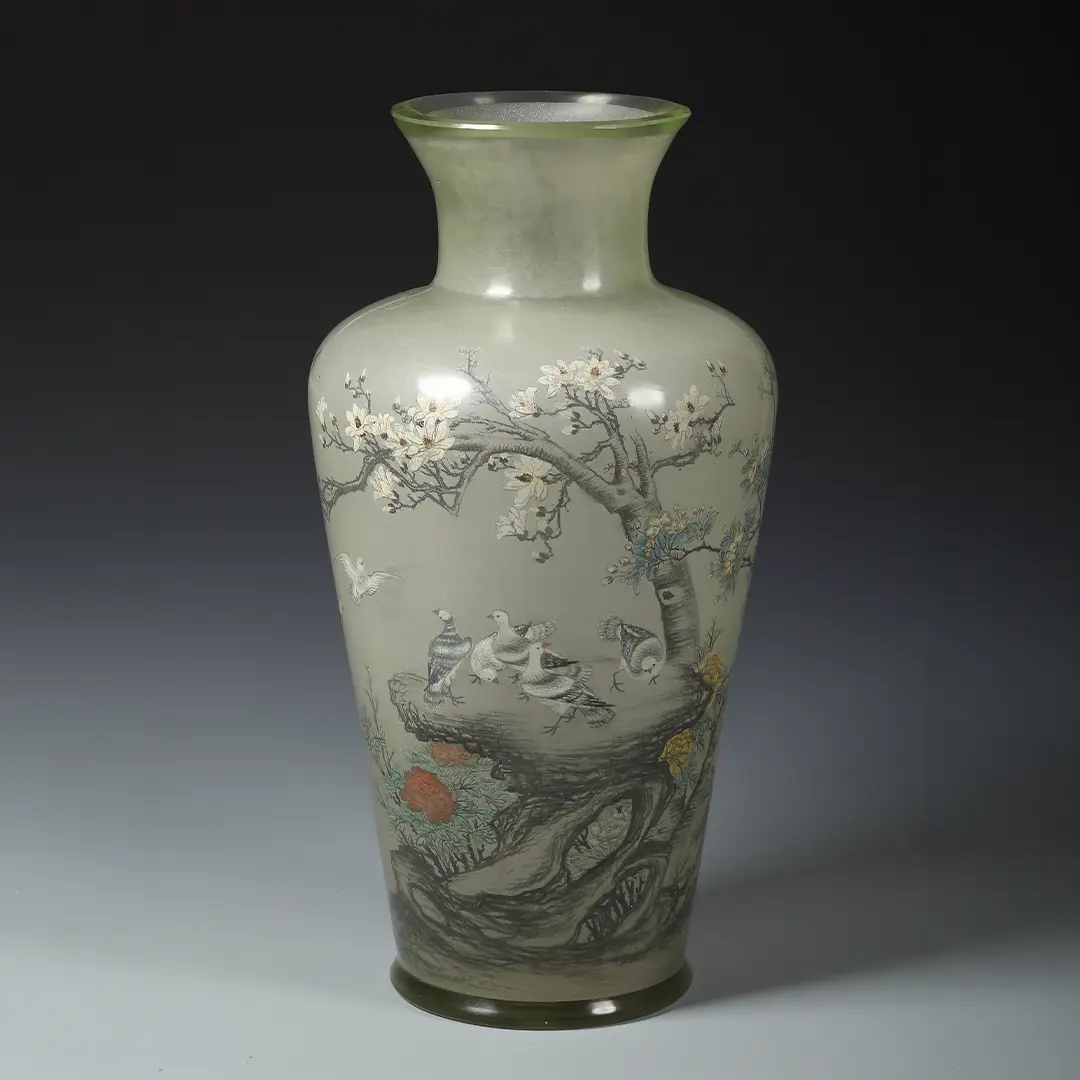
Contemporary
Xue Jingwan
Belly diameter 22.2 cm; Height 42.4 cm
Spring of Peace
This snuff bottle, titled Spring of Peace, is a work by Xue Jingwan, a master specialized in inside painting. Inside painting is an extraordinarily challenging craft where artists use a specialized curved brush inserted into the narrow opening of a glass vessel to paint in reverse along its inner walls. Introduced to Zibo in the late Qing Dynasty, this technique gradually evolved into the distinctive regional style known as the Shandong School of Inside Painting.
Titled Spring of Peace, the work presents a scene of blooming magnolias and peonies, accompanied by rocks and white doves. Painted within a pale green liuli vessel, the composition evokes the freshness of spring and an atmosphere of harmony and tranquility.
Delicate in execution and rich in detail, the work exemplifies the refined artistry for which the Shandong school of inside painting is renowned.
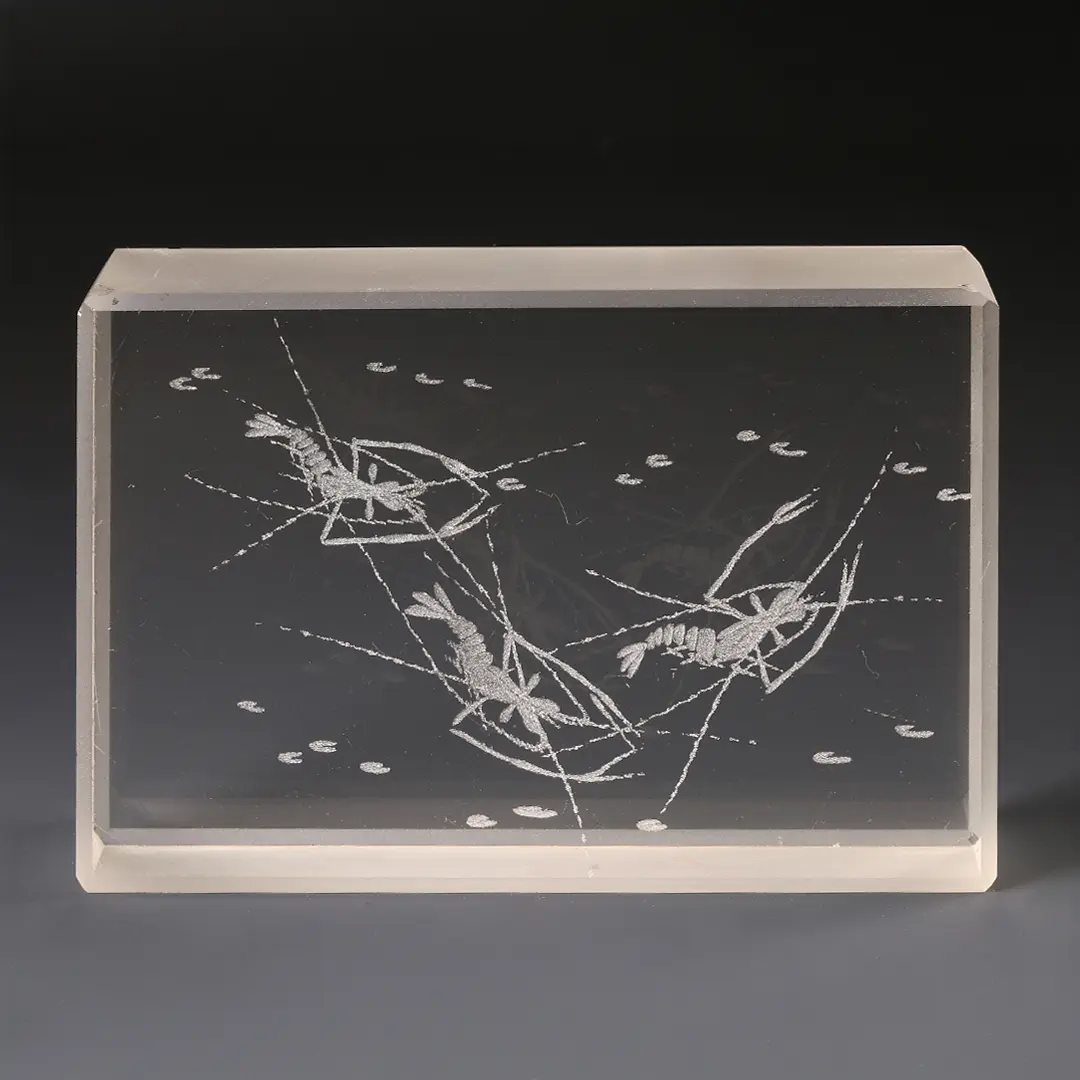
Contemporary
Lyu Guisen
Length 10.5 cm; Width 2.9 cm; Height 7.3 cm
Shrimp
Shrimp, created by artist Lyu Guisen, draws inspiration from Qi Baishi’s iconic ink paintings of shrimp. Carved on a block of crystal-clear glass are three swimming shrimp accompanied by fine, scattered water bubbles, It seamlessly blends the essence of traditional Chinese ink painting with the art of glassmaking.
The work utilizes the incising technique of Zibo liuli, which requires precise control of knife pressure throughout the craving process, making it exceptionally challenging. The lifelike bodies, claws, and feelers of the shrimp demonstrate both the artist's technical virtuosity and the unique expressive power of Zibo liuli.
Contemporary
Ren Yunpeng
Length 30 cm; Height 50 cm; Thickness 12 cm
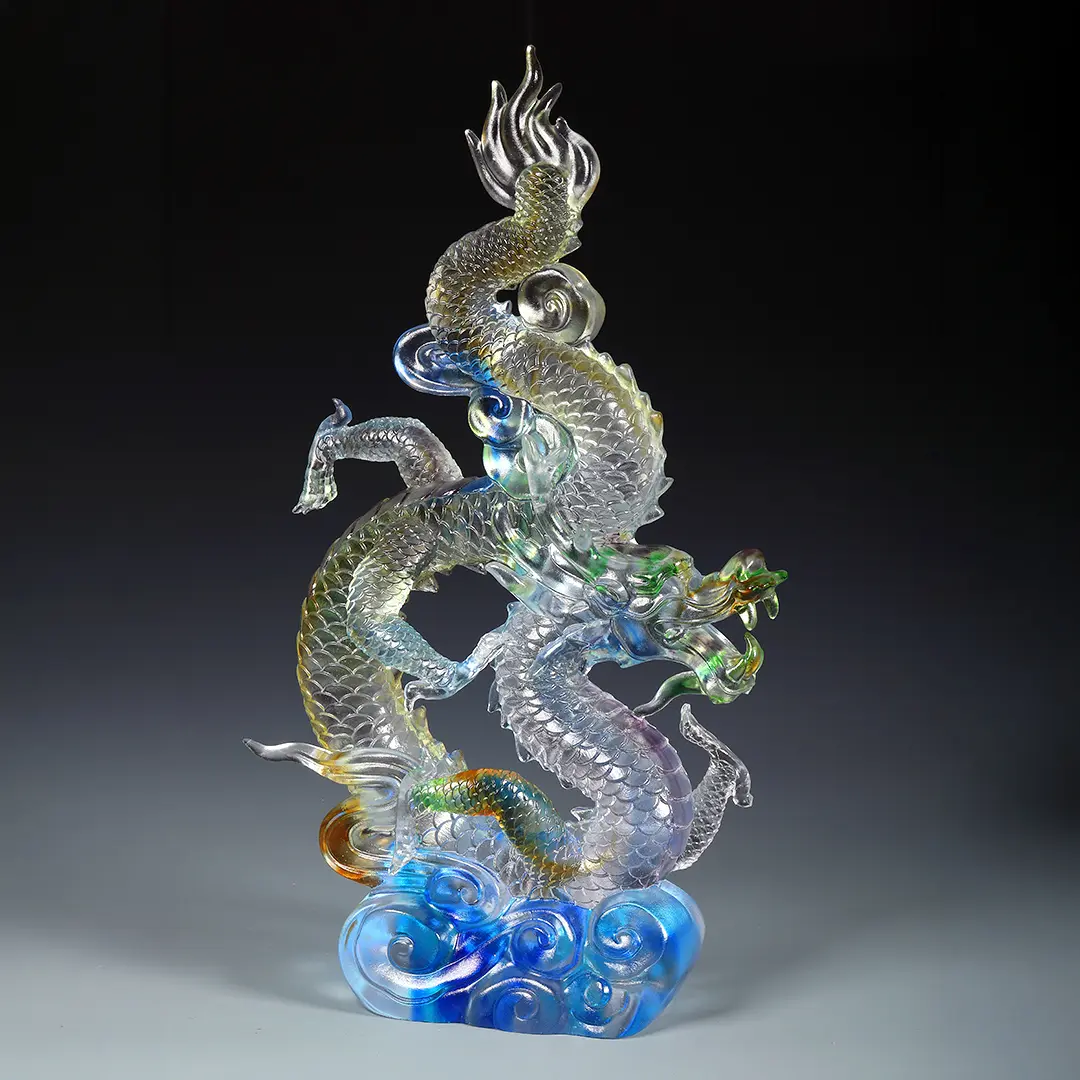
Liuli Dragon of the Celestial Cycle
Liuli Dragon of the Celestial Cycle is cast as a single piece from multicolored transparent liuli using traditional lost-wax casting technique. Rising through swirling clouds, the auspicious dragon embodies the ideals of aspiration, progress, and prosperity that it has long symbolized in Chinese culture.
The lost-wax casting process allows different colors of liuli to fuse naturally at high temperatures, creating flowing patterns and subtle variations throughout the sculpture. These shifting colors and textures enhance the sense of movement, giving the dragon an energetic and dynamic presence. Large three-dimensional liuli works are exceptionally demanding to produce. Every stage, from casting and annealing to grinding and polishing, requires careful control and precision. Through its commanding form and intricate coloration, the work reflects the artist's considerable mastery of the medium.
Contemporary
Wang Kaibing
Left: Belly diameter 25 cm; Height 38 cm
Right: Belly diameter 27 cm; Height 24 cm
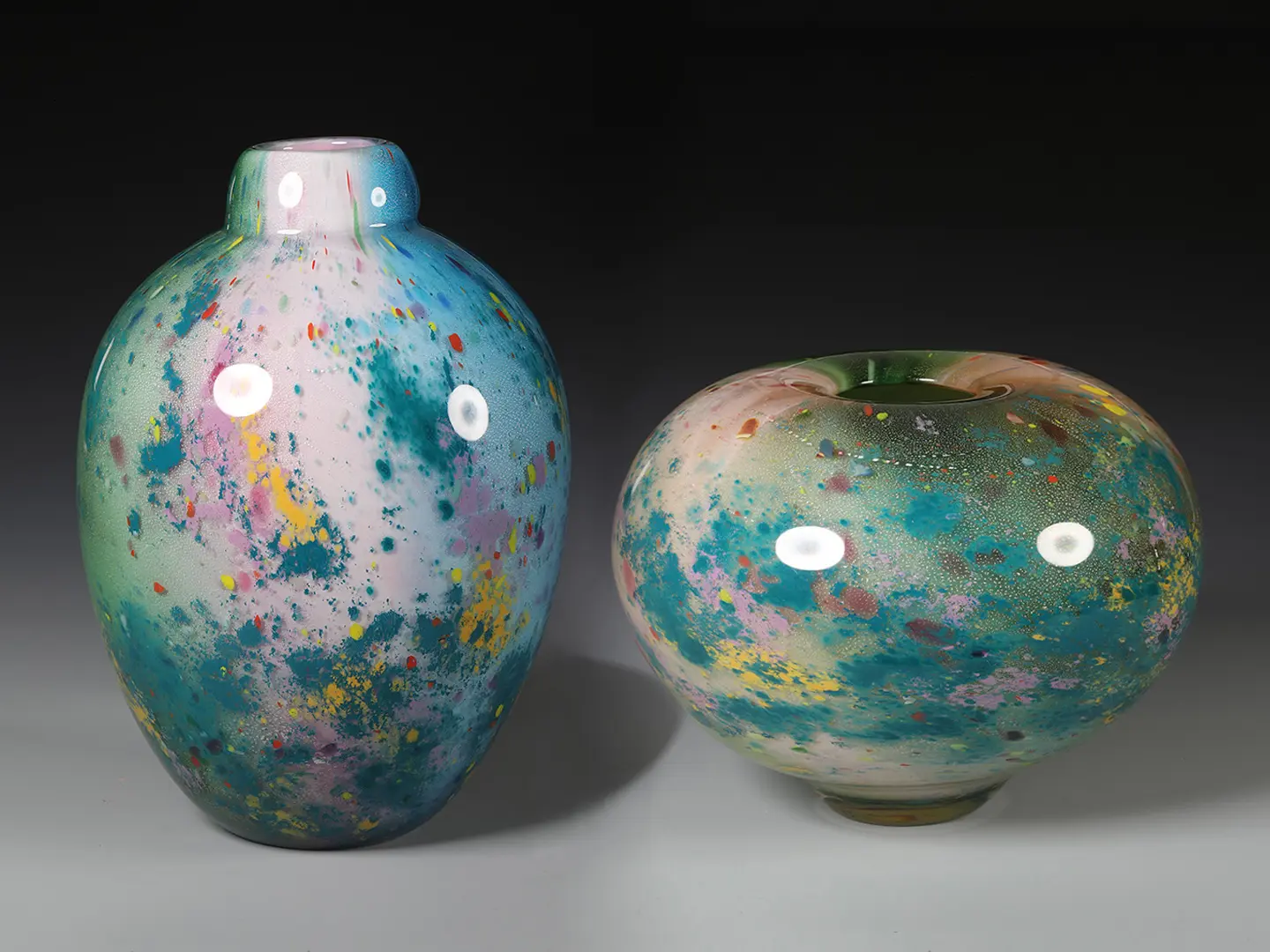
Monet's Garden
Monet’s Garden is crafted by contemporary liuli artist Wang Kaibing. Drawing inspiration from the paintings of the Impressionist master Claude Monet, the artist blends green, blue, pink, red, and yellow pigments into molten glass, allowing the colors to drift and mingle in soft, shifting layers. The result evokes the dappled light and softly blurred vegetation of a garden landscape.
The process of firing liuli is inherently unpredictable, making every work unique in its colors and patterns. In this respect, the piece echoes Monet's paintings, which capture the shifting colors created as sunlight falls across flowers and foliage. It invites the viewer's imagination to wander through a poetic arcadia.
Contemporary
Liu Tao
Belly diameter 15 cm; Height 31 cm
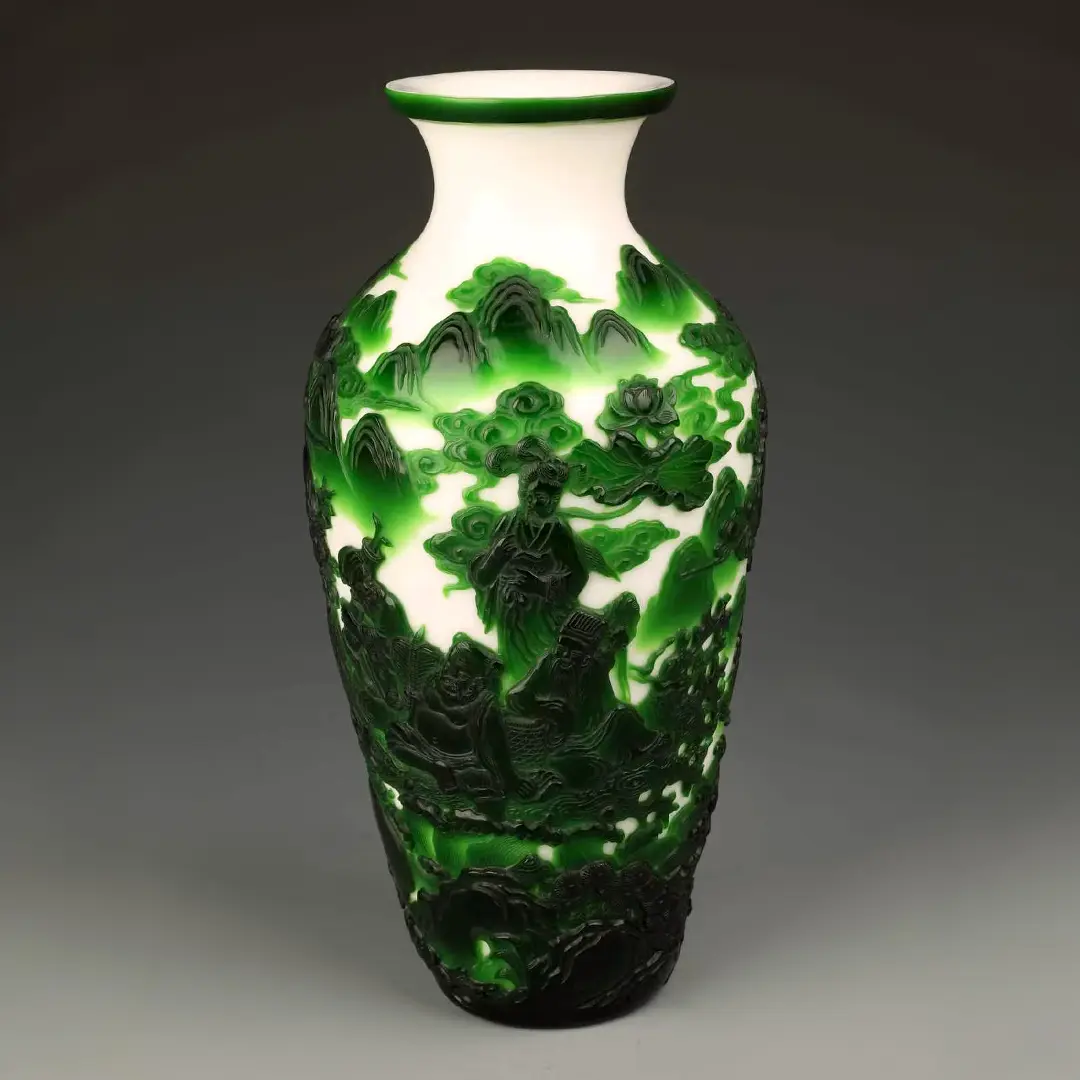
Layered Verdure of Streams and Mountains
Layered Verdure of Streams and Mountains is a work by Artist Liu Tao and an exemplar of Boshan’s overlay-liuli carving tradition. Created from a double layer of white and green liuli, the bottle features a white inner layer overlaid with emerald-green liuli, which is then carved in varying depths to create a mountainous landscape. The distant mountains and pavilions are rendered using shallow carving, their lines light and fluid. In the foreground, eight immortals, auspicious clouds, lotus flowers, and lotus leaves are executed in deeper relief, bringing greater definition and depth to the composition. Together, these layers create the effect of a landscape unfolding through space.
Overlay carving in double-layered liuli is an exceptionally demanding technique. As the two layers of liuli expand and contract at different rates, the material is highly susceptible to cracking during carving. Finely executed and remarkably preserved, this work has the milky-white inner layer intact, making a particularly accomplished example of the craft.
Contemporary
Sun Lei
Length 34 cm; Width 32 cm; Height 44 cm
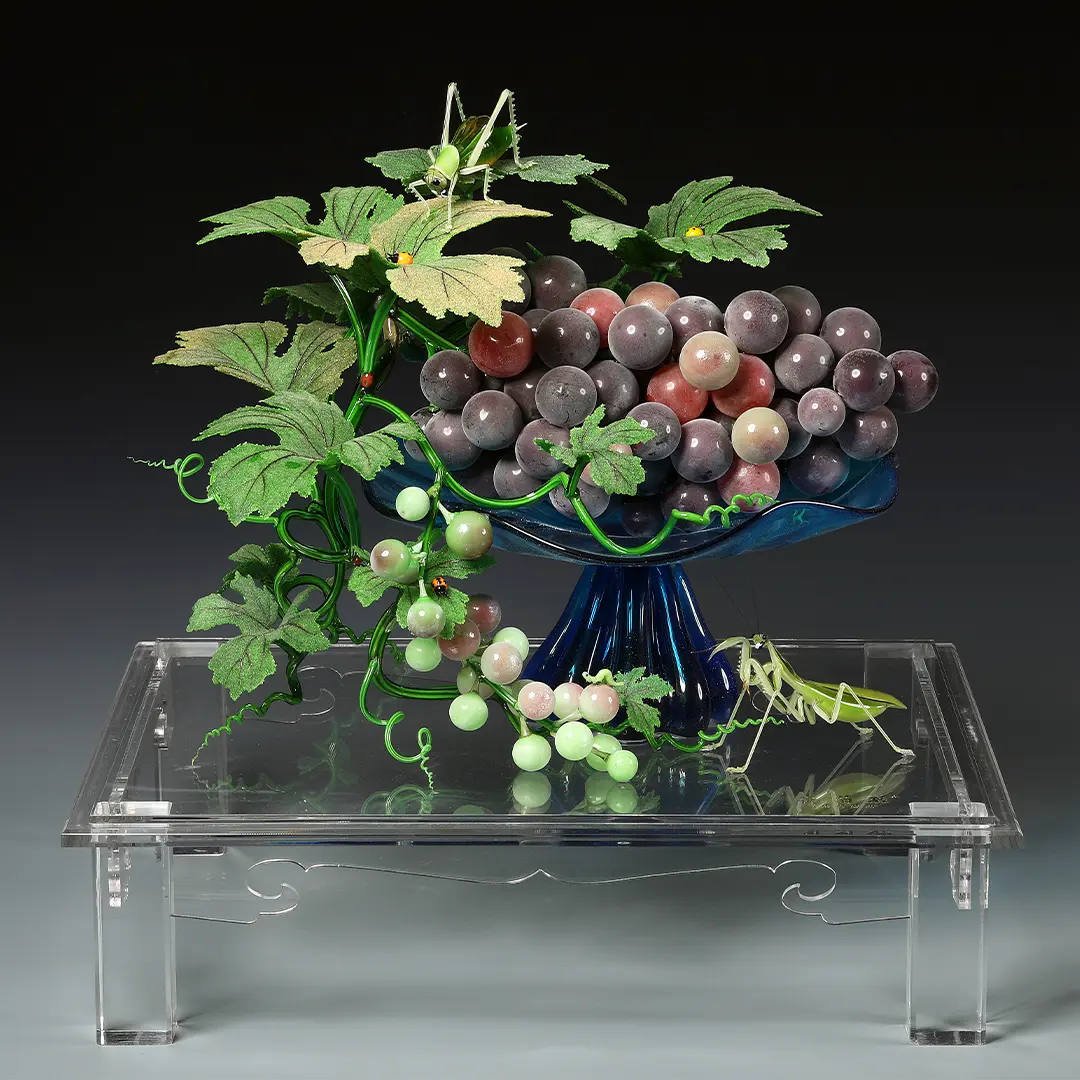
Peace Year after Year
Peace Year after Year is an exquisite lampworked liuli artwork created by contemporary artist Sun Lei. Rendered with striking realism, the grapes are plump and rounded, each featuring subtle variations in shade that faithfully capture the rich color gradations of fruit approaching full ripeness.
In traditional Chinese culture, the grape—with its abundant fruit and sprawling vines—symbolizes a bountiful harvest, wealth, and a large, prosperous family. In addition to the grapes cascading along the vine, a tiny praying mantis sits quietly nearby, adding a lively touch of dynamic detail that breathes life into the serene composition.
Contemporary
Song Miao, Wang Yifan
Each: Length 20 cm; Width 20 cm; Height 40 cm
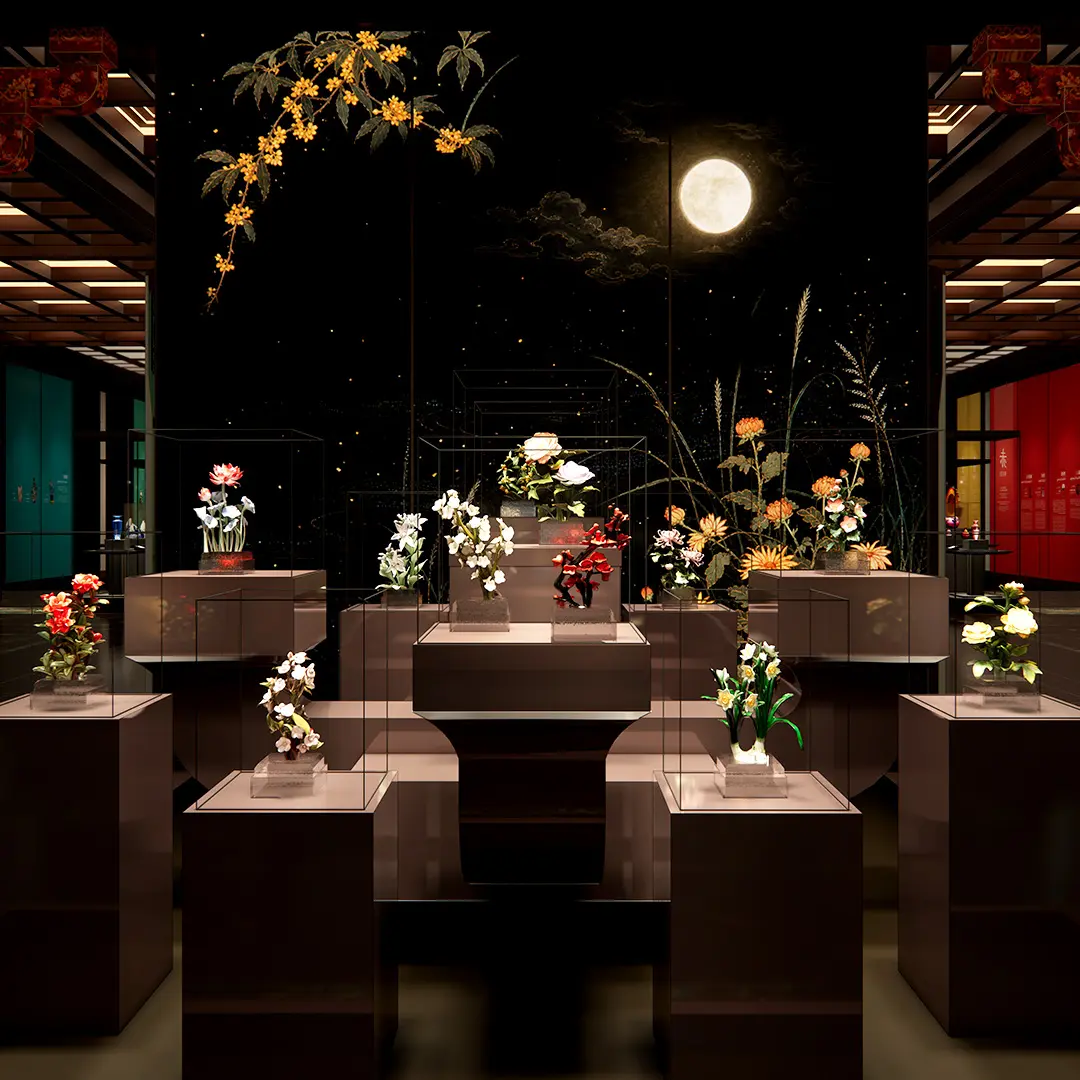
The Twelve Flower Deities
The Twelve Flower Deities is a series of lampworked liuli artworks, jointly created by contemporary liuli artists Song Miao and Wang Yifan, inspired by the folk legend of the Twelve Flower Deities. The series captures the traditional Chinese appreciation of seasonal beauty and the romance found in life's gentler moments.
In traditional Chinese culture, each month is associated with a specific flower—such as the plum blossom in January or the osmanthus in August—carrying wishes for a beautiful life. Utilizing lampworking techniques combined with specialized color-blending methods, different glass pigments merge naturally to create rich gradations across the petals. Arranged according to the lunar calendar, these twelve glass flowers capture each bloom at its finest moment, freezing the flowing seasons into a single, breathtaking view.
Contemporary
Sun Fengjun, Sun Lei
Length 102.5 cm; Width 38 cm; Height 58 cm
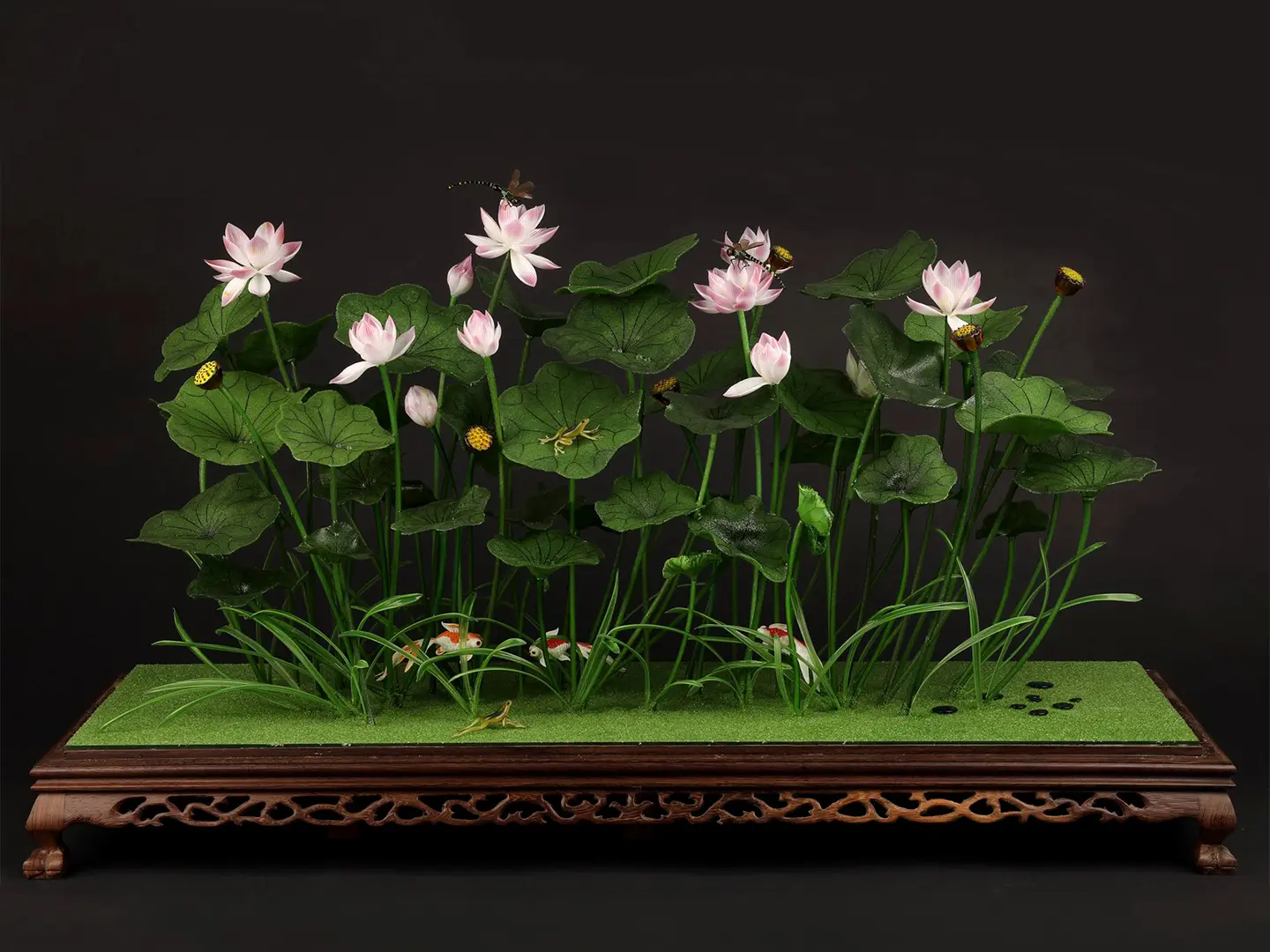
Pure Lotus
Pure Lotus is a lampworked liuli artwork, jointly created by contemporary liul artists Sun Fengjun and Sun Lei. Of exceptional naturalism, this work takes a lotus pond as its central theme. Wind-blown lotus flowers, seed pods, and unfurled leaves take center stage, accented by lifelike swimming fish, dragonflies, and insects that add a sense of vitality to the scene. Crafting each detail requires precise temperature control and repeated annealing, which showcase the artisan's consummate skill.
Beyond its natural beauty, the lotus holds special significance in Macao, where it serves as the city's floral emblem and an important cultural symbol. Its alternate Chinese name, lian (蓮), shares its pronunciation with the word for "connection", expressing the hope that Macao and the motherland remain closely linked and prosper together.
Contemporary
Ren Bo
Length 88 cm; Width 72 cm; Thickness 15 cm
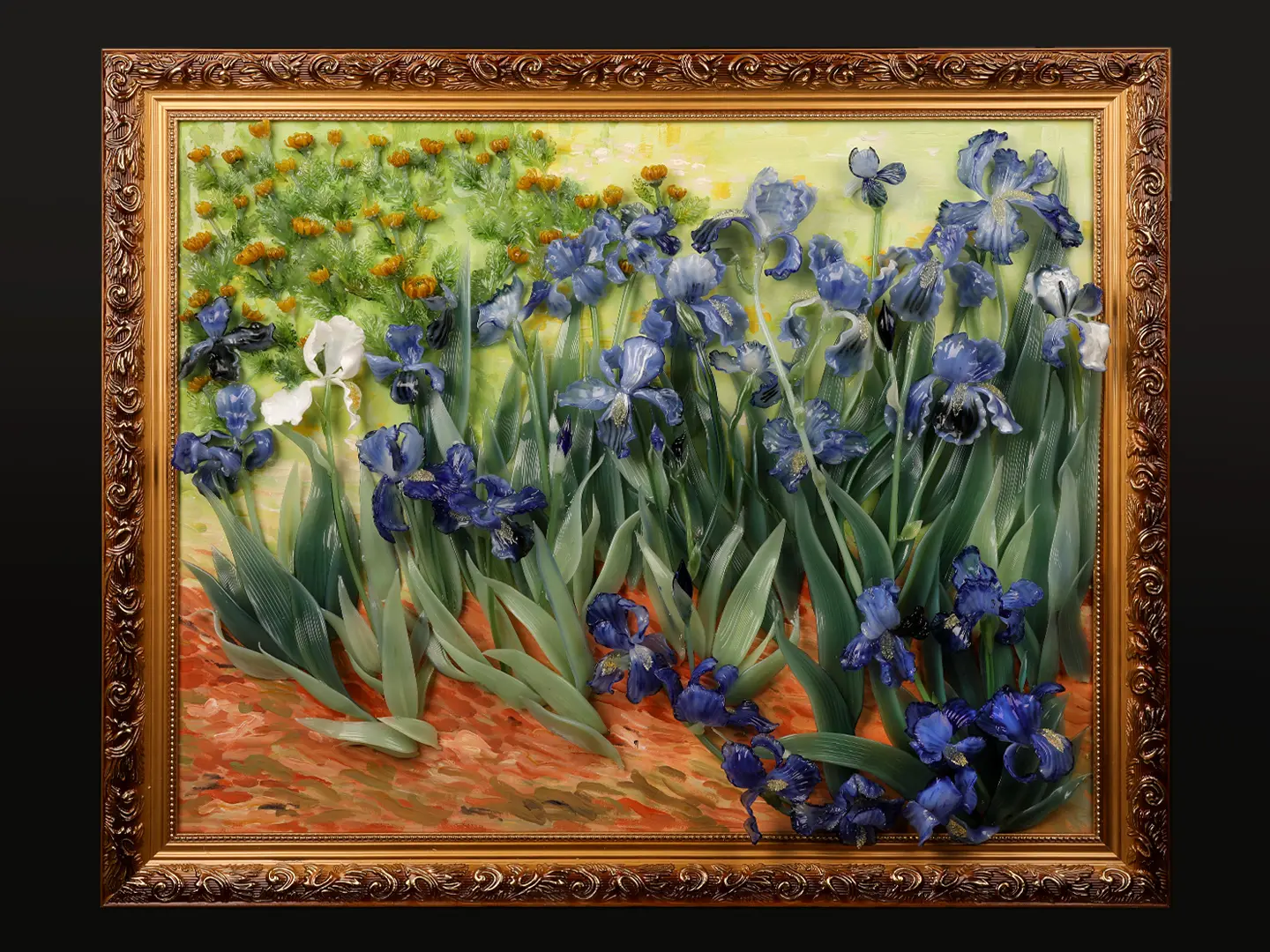
Iris
Irises is a work by the contemporary artist Ren Bo, it is a three-dimensional liuli painting inspired by Vincent van Gogh’s celebrated painting of the same title. Utilizing traditional lampworking technique, the work reproduces the expressive vitality of the original through the medium of glass.
Lampworking involves heating liuli rods over the flame of a torch until they become molten and malleable, allowing the artist to shape them by hand. In this work, each curling leaf and folded blade is individually heated, formed, and cooled with great precision, to imitate the brilliant vividness of van Gogh’s brushwork. The result brings China's intangible heritage of liuli craftsmanship into dialogue with the artistic legacy of Post-Impressionism.
Contemporary
Ren Bo, Tang Zhenzhen
Length 50 cm; Width 50 cm; Height 168 cm
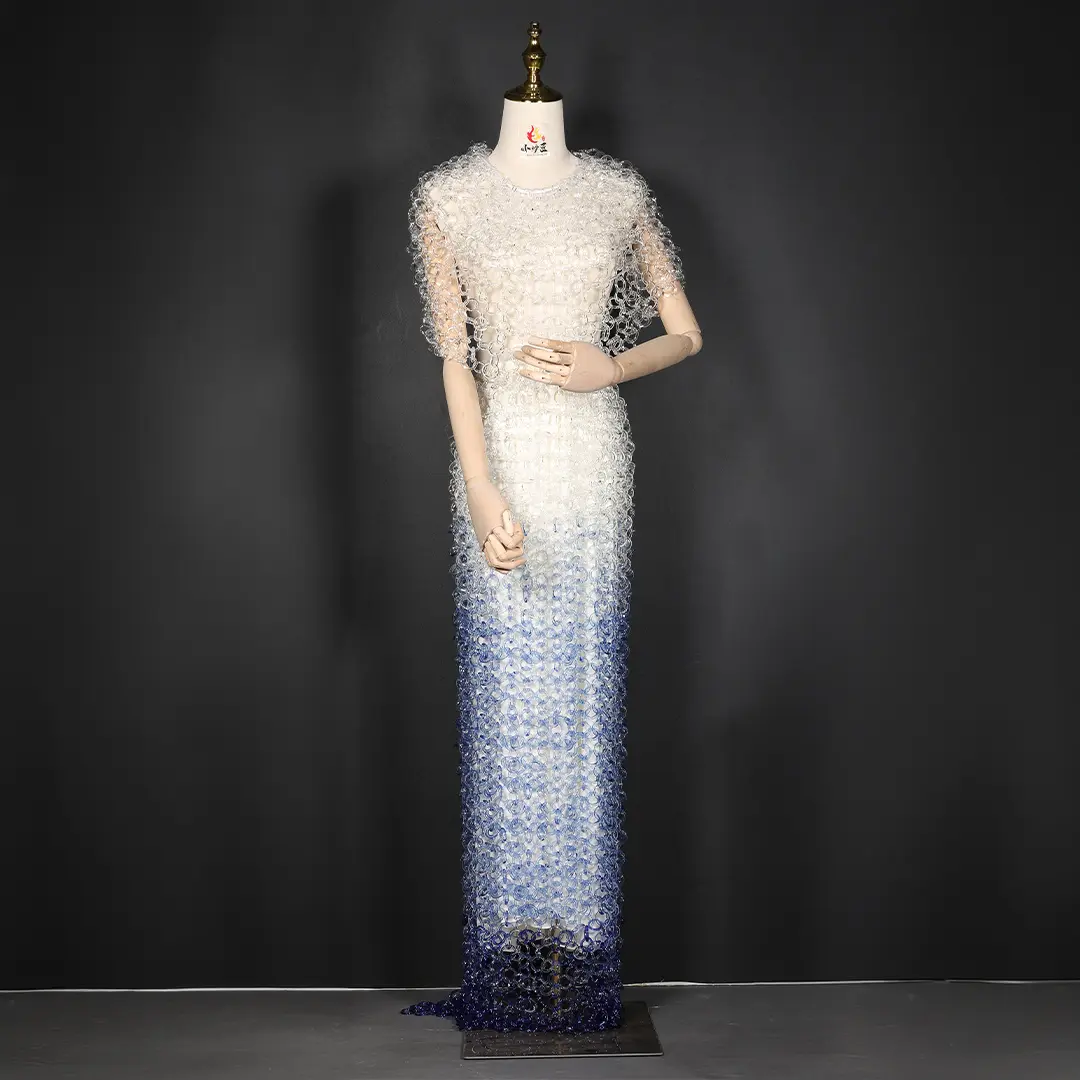
A Thousand Rings: The Radiant Liuli Gown
A Thousand Rings: The Radiant Liuli Gown is a collaborative work by artists Ren Bo and Tang Zhenzhen and was featured in the 2026 CCTV Intangible Cultural Heritage Gala.
Weighing 13 kilograms, the gown is woven from over 7,000 individually handcrafted glass rings. Through an extraordinarily complex process, it breaks through the traditional thousand-year boundaries of liuli as merely vessels or ornaments, transforming it into wearable fashion. As the wearer moves, the crisp sound of the clashing liuli rings resonates with the shimmering light refracted across its surface, presenting a brilliant contemporary expression of liuli art.
Contemporary
Luan Qingyan
Length 65 cm; Width 35 cm; Height 90 cm
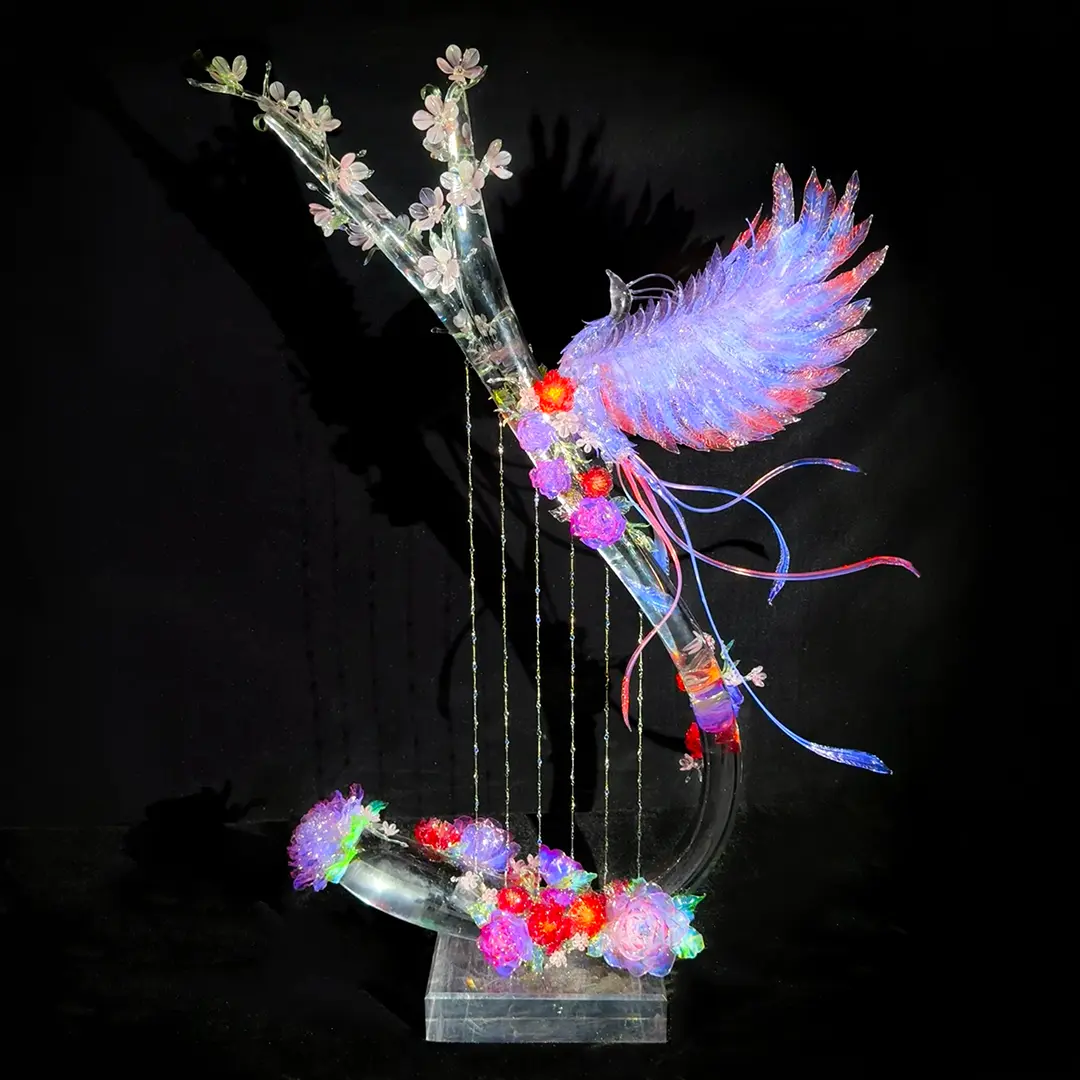
Liuli Reverie‒Phoenix Resting upon Strings
By artist Luan Qingyan, Liuli Reverie–Phoenix Resting upon Strings takes the ancient Chinese musical instrument, the konghou, as its central motif, subtly infusing it with the auspicious symbolism of the phoenix from traditional Chinese culture.
Perched upon the strings, the phoenix is crafted from gradient liuli transitioning from purple to pink. Its layered wings unfurl gracefully, playing off the static and dynamic forms of the liuli blossoms adorning the harp's frame, neck, and base. Beyond creating a breathtaking visual composition, the imagery of a phoenix resting on the strings suggests a harmonious blend of music and phoenix song, evoking the melody of a heavenly realm.
Contemporary
Ren Bo
Total four scenes
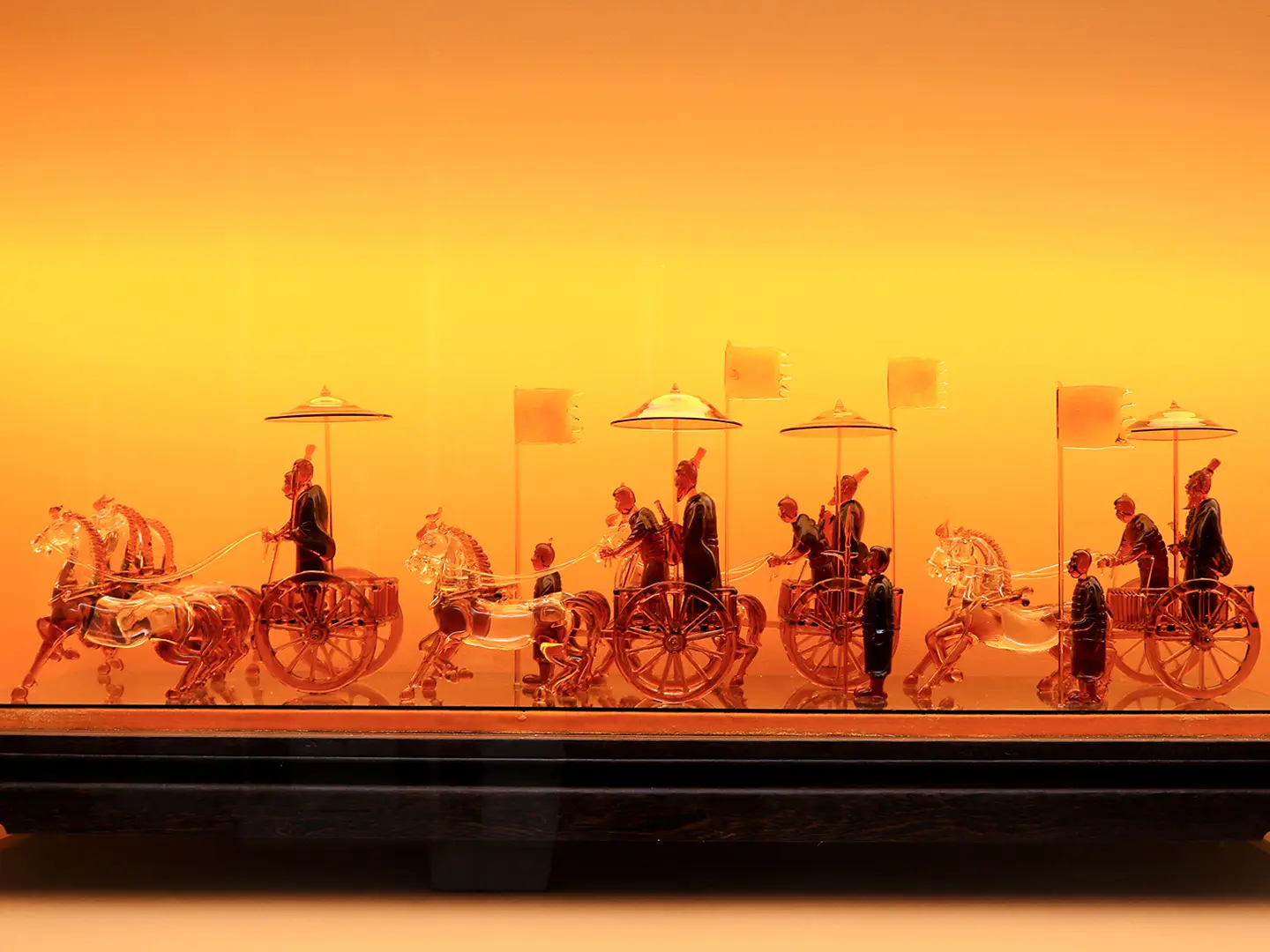
The Enfeoffment of Qi by Grand Duke Tai-Series
Created by artist Ren Bo, The Enfeoffment of Qi by Grand Duke Tai is a series of works that utilize lampworked liuli micro-carving techniques. Zibo, renowned for its glass craftsmanship, was once the heartland of the ancient State of Qi. Through small, translucent glass miniatures, the artist portrays the grand chapter of Grand Duke Jiang Taigong being enfeoffed in Qi and laying the foundation for its rich culture.
The work is composed of four distinct chapters. The first depicts Jiang Taigong journeying to Qi to expand its territory, capturing the grandeur of horses and chariots within a compact space. The second portrays Qi’s rapid economic growth under his policy of encouraging commerce, crafts, fishing, and salt trade, vividly illustrating everyday people hard at work. The third represents the large-scale royal dance and music performance, Qi Shao, showcasing the flourishing social culture under his governance through regional music. The fourth shows Jiang Taigong promoting sericulture and silk weaving, driving economic prosperity and ultimately establishing Qi as a dominant power.
Contemporary
Wang Jingyao
Length 42 cm; Width 25 cm; Height 30 cm
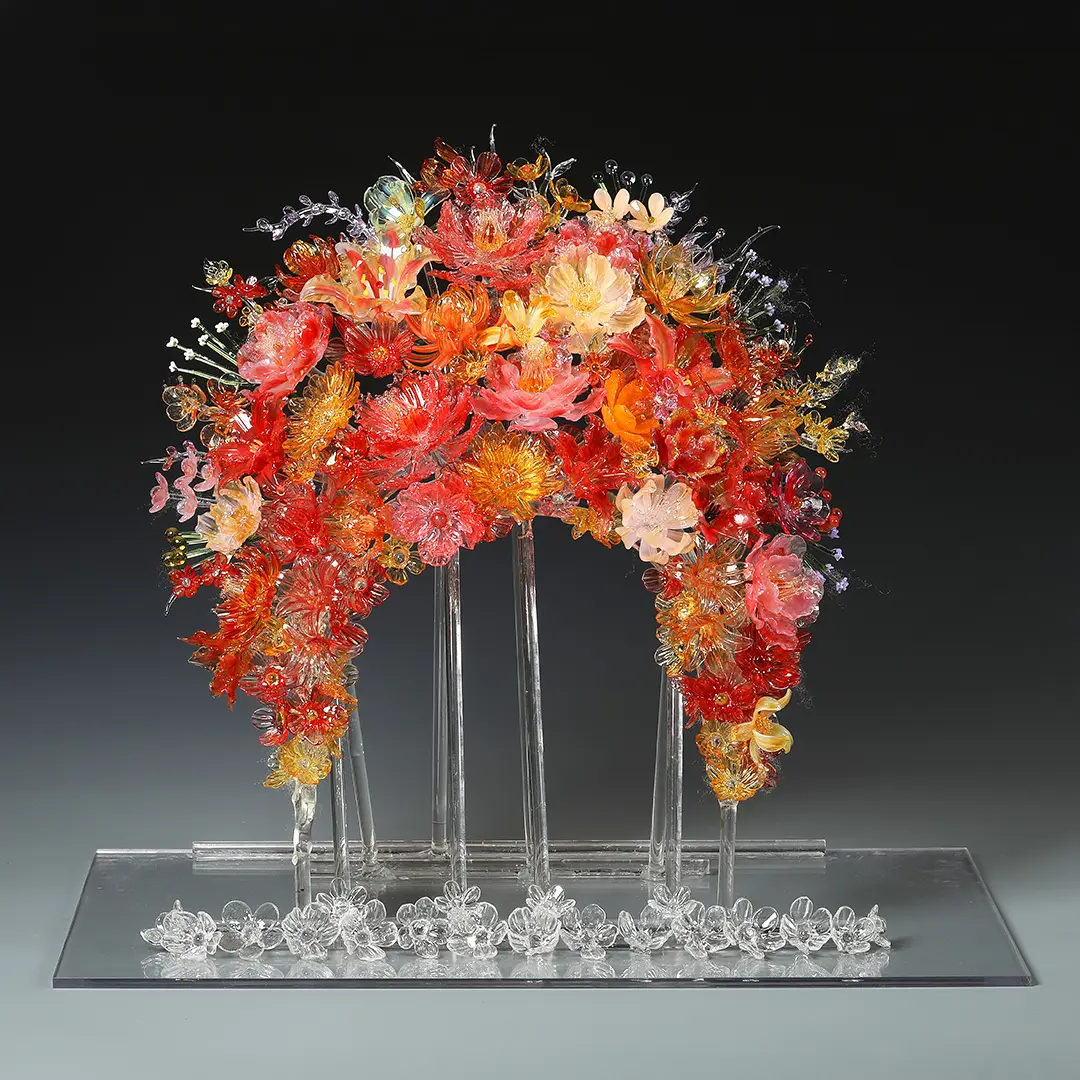
Flourishing Blossoms
Flourishing Blossoms is a lampworked liuli artwork created by artist Wang Jingyao, it with inspiration from Quanzhou’s famous Zanhua (flower-headdress), a form of intangible cultural heritage in Fujian Province. In this long-standing custom, local women wear elaborate floral headdresses known as zanhuawei. Drawing on the lustrous qualities of liuli, the artist imbues the flowers with a light and delicate presence, reimagining a folk heritage rich in everyday charm into a luminous work of art.
By bringing together two forms of intangible cultural heritage, Zibo liuli and Quanzhou's flower-adornment tradition, the work fosters a dialogue between traditional folk culture and contemporary craftsmanship, creating new possibilities through innovation. With its profusion of flowers, it conveys wishes for abundance, prosperity, and the flourishing of all things.
2000
Dale Chihuly
Collection of POLY MGM MUSEUM
Length 68 cm; Width 63 cm; Height 40 cm
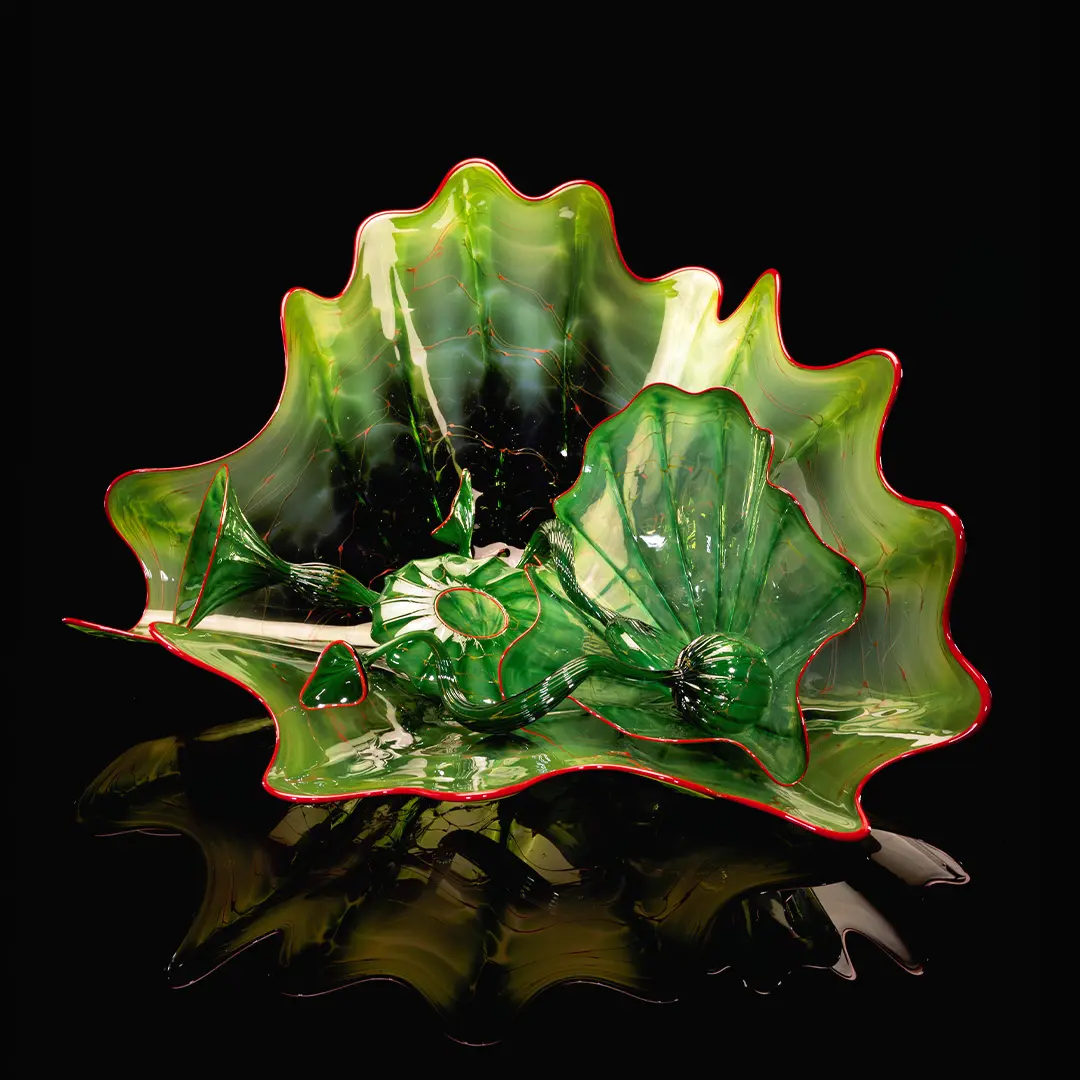
Greenpersi & Cherrywrap
The Persians series is among the celebrated creations of the world-renowned glass sculptor Dale Chihuly. Famous for its vivid, high-saturation colors, the series draws inspiration from organic natural forms such as marine life, flowers, and curling flora. It breaks through the traditional impression of glass as cold and rigid, imbuing the material with dynamic energy and dramatic vitality through a brilliant play of light and color.
For Chihuly, the Persians series evokes a sense of ancient history and brings to mind cultural imagery from Venice, the Near East, and the Far East. These works can be fashioned into striking large-scale wall installations and suspended ceiling displays, or assembled into chandeliers and towering sculptural structures.